Key Takeaways
- Keep pink pregnancy seats available: pregnancy may not be visible, so do not wait for someone to ask you to move.
- Priority rows serve several groups: older adults, disabled passengers, pregnant riders and injured people may need them.
- Safety beats the informal rush-hour habit: on escalators, follow current signs, stand securely and hold the handrail instead of treating one side as a walking lane.
1. The Pink Pregnancy Seat
Seoul subway cars use clearly marked pink seats and floor graphics for 임산부 배려석, seating reserved for pregnant passengers. Early pregnancy may be invisible and asking a stranger to move can be difficult. The considerate choice for a traveler who is not eligible is therefore simple: leave the seat available, even when the car is busy.
This is best understood as an accessibility and courtesy rule, not an invitation to judge another passenger. Do not challenge someone using the seat; a rider may have a need that is not visible.
2. Priority Rows at the Ends of the Car
The grouped seats near the ends of many cars are marked 노약자석 or as transportation-priority seating. They are intended for older adults, disabled passengers, pregnant passengers, injured riders and others with reduced mobility.
3. Escalator Safety: Do Not Assume a Walking Lane
You may still see commuters stand to one side and other people walk past, but that habit is not a reliable safety instruction. Walking or running on an escalator increases fall risk, especially with rolling luggage, and local safety campaigns may ask riders to stand rather than walk.
- Face forward, stand inside one step and hold the handrail.
- Follow the sign or staff instruction at that station instead of enforcing a left/right custom yourself.
- Keep suitcase wheels fully on one step and never leave luggage across the landing.
- Use an elevator with a stroller, wheelchair, very large bag or limited mobility.
4. Let Riders Exit Before Boarding
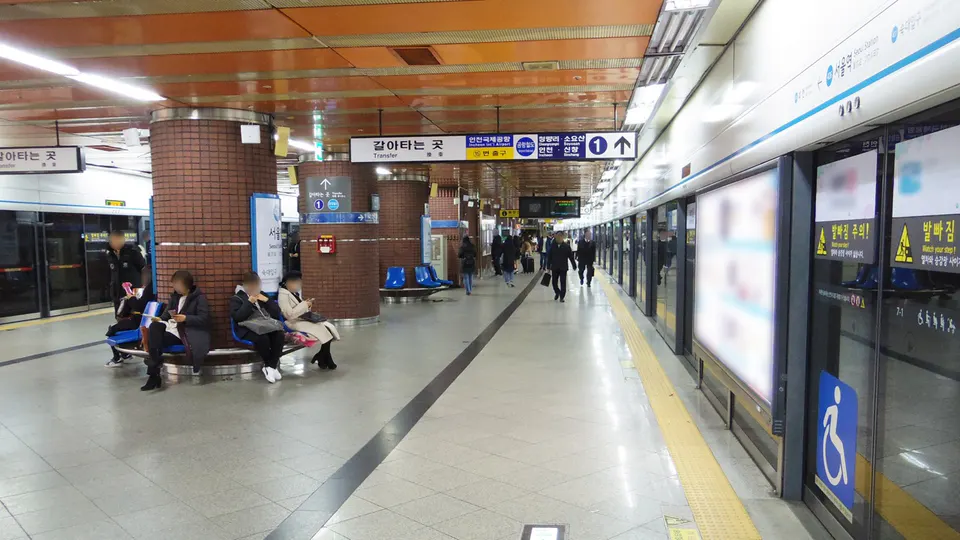
Queue beside the platform-door markings and leave the center clear. When the doors open, wait until passengers have stepped off before entering. Do not stop immediately inside the doorway; move toward the center of the car when space allows. On a crowded train, remove a large backpack and hold it low in front of you so it does not strike other riders.
5. Phone Calls, Food and Personal Space
- Calls: keep them short and quiet; use headphones for audio and never play sound through the speaker.
- Food: avoid strong-smelling meals and open drinks in crowded cars. Finish messy food before boarding.
- Doors: do not lean on platform doors or block the doorway while checking a map.
- Rush hour: prepare to exit one stop early and say 잠시만요 (jam-si-man-yo), “excuse me,” rather than pushing silently.
6. A 20-Second Traveler Checklist
- Check the line, direction and final destination shown on the train.
- Queue beside the door and let people exit first.
- Keep reserved seating open unless you are eligible.
- Hold bags close and keep audio private.
- Follow posted escalator and safety instructions.
- Check the last useful train—not merely the station closing time.