- Check the table before asking: many restaurants keep spoons, chopsticks and napkins in a drawer under the tabletop.
- One press is enough: use the call button or say 여기요 (yeogiyo) once; water or extra side dishes may be at a self-service station.
- Read the house rules: banchan is usually included and tipping is not expected, but minimum orders and refill limits vary by restaurant.
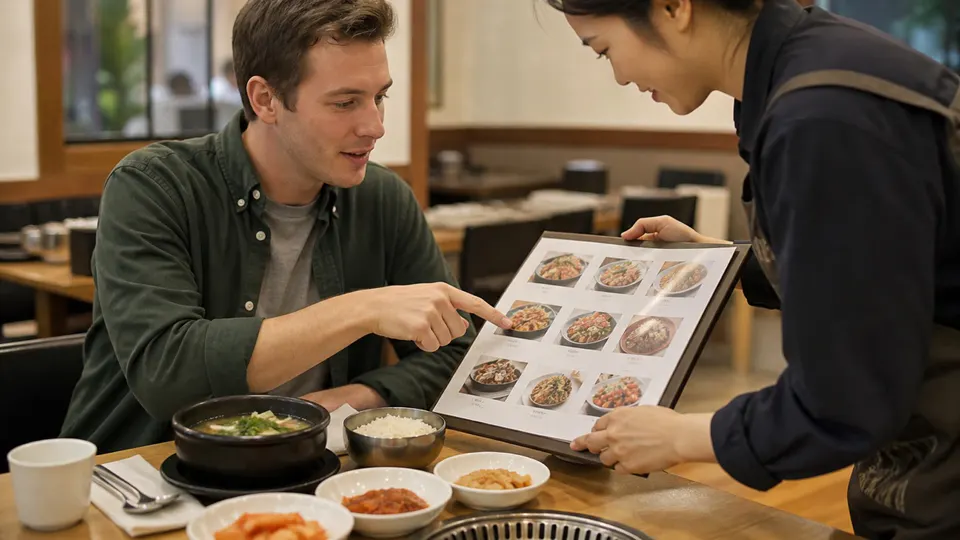
Three table surprises before you order
First, feel below the table edge for a shallow drawer. Many Korean restaurants store metal spoons, chopsticks and napkins there rather than setting them on top. Second, a small call button lets you request service without waiting for eye contact. Press it once, then ask briefly. 여기요 (yeogiyo, “excuse me here”) is the safest neutral call. You may hear 사장님 (sajangnim, owner/manager) or the familiar 이모님 (imonim, “auntie”) in casual venues, but do not assume either title fits every worker. Third, signs reading 물은 셀프입니다 mean water is self-service; look for a dispenser and cups.
Banchan refills and sharing
Basic side dishes are normally included with the meal, and common banchan can often be refilled without a separate charge. That does not mean every premium, seasonal or portion-limited item is unlimited. If there is a self-service bar, take only what your table will finish. Otherwise press the bell and say 반찬 더 주세요 (banchan deo juseyo, “more side dishes, please”). Share banchan from the center and use serving utensils when provided. For more grill-specific customs, see the Korean BBQ ordering and etiquette guide.
Minimum orders are house policies, not national law
Many restaurants expect each diner to order one main item, while barbecue and shared-pan dishes such as dakgalbi commonly require an initial order of two servings. These are menu or restaurant policies, not universal Korean law. Check phrases such as “minimum two portions” on the menu, and ask before sitting if you are dining alone. A single-person set, stew, noodle dish or lunch special may be an easier alternative. Use the Naver Map versus Kakao Map guide to verify the exact branch, and the Seongsu neighborhood guide when planning a meal there.
Paying and tipping
At many casual restaurants, you eat first and take the table number or bill to the counter when leaving. Kiosks, prepayment and pay-at-table systems also exist, so follow the sign or staff direction. Splitting a bill across several cards may not be supported during busy service. Tipping is not expected in ordinary Korean restaurants: pay the stated total and do not leave cash on the table unless the business explicitly offers a tipping option. Before leaving, check the utensil drawer area, chair and under-table basket for your phone or bag.
- 여기요 — Yeogiyo — Excuse me.
- 반찬 더 주세요 — Banchan deo juseyo — More side dishes, please.
- 계산할게요 — Gyesanhalgeyo — I would like to pay.
What’s Actually Free in Korean Restaurants
Visitors are often surprised by what a standard Korean restaurant includes with the meal. Water, basic side dishes and tax-inclusive menu pricing are common, but the exact refill policy remains a house rule. Check the menu or ask before treating a premium item as unlimited.
1. Water is normally free—and often self-service
Casual restaurants commonly provide drinking water without requiring a beverage order. A sign reading 물은 셀프 (mureun self, “water is self-service”) points to a dispenser, pitcher or cups; other venues bring water to the table. Some Korean barbecue and traditional restaurants serve barley tea (보리차, boricha) instead of or alongside plain water. The dispenser setup and water source vary by business, so the useful rule is simply to follow the posted self-service sign.
2. Basic banchan and many refills are included
Order a main dish at many Korean restaurants and several small side dishes—banchan (반찬)—arrive without a separate line-item charge. Standard kimchi, pickles and simple vegetables can often be refilled. Point to the dish and say 이거 좀 더 주세요 (igeo jom deo juseyo, “a little more of this, please”). If the restaurant has a designated banchan bar, take only what the table can finish.
3. Menu prices generally include VAT, and tipping is not expected
Consumer-facing restaurant prices generally include applicable VAT, so the displayed menu total is usually the amount charged. Tipping is not expected at ordinary restaurants, cafés or bars; pay the stated bill rather than leaving cash on the table. Some hotels or premium venues disclose a service charge, and optional tipping in private-guide or driver services depends on the provider and booking terms. Check the bill for a stated service charge instead of adding one automatically.
Official sources
Time-sensitive details were checked against the original sources below on 2026-08-29.