The quick answer
Korea has more than one tourist tax-refund route. At a participating store, an eligible visitor may receive an immediate refund at checkout. A purchase that does not use that route may be handled at a downtown refund counter or during departure at an airport or port. Duty-free shopping is different: tax is excluded when the item is sold, rather than refunded after a tax-inclusive purchase.
| Route | Useful when | Main caution |
|---|---|---|
| Immediate refund | The participating store can verify eligibility at payment | Transaction and trip-total limits apply |
| Downtown refund | You want to process before departure | You may still need export confirmation at departure |
| Airport or port | The purchase was not refunded earlier or requires departure processing | Keep documents and possibly the goods accessible |
Check eligibility before counting the savings
The current KTO guide lists foreign visitors staying in Korea for up to six months among the eligible groups. It also covers qualifying overseas Koreans under separate residence and stay conditions. The goods must leave Korea within three months of purchase. People earning income in Korea, long-term residents and purchases made under a corporate name or through an agent may not qualify.
The store must participate in the tourist refund system, and not everything sold or paid for is refundable. KTO excludes items that cannot be visually verified by customs, opened or used goods, prohibited goods and items already purchased duty-free. Services such as a meal or massage do not become refundable shopping goods merely because a visitor paid VAT.
Immediate refund: easiest when it is available
For an immediate refund, show your passport or the verification method accepted by the participating store before payment is finalized. The current official guide says a single transaction must be at least KRW 15,000 and below KRW 1 million, while the combined qualifying purchase amount during the trip must be KRW 5 million or less.
Confirm that the tax reduction actually appears on the payment record. A normal receipt, a tax-refund record and an immediate deduction are not interchangeable. If the store cannot process an immediate refund, ask whether it can issue the correct document for a later claim. Do not assume every branch of a chain provides identical processing.
Downtown refund: earlier cash does not end the process
Downtown counters can be convenient when several purchases are already documented, but each operator may process only its own refund records. You may also be asked for an international credit card as security. Most importantly, receiving money downtown does not necessarily remove the requirement to confirm that the goods leave Korea.
Keep the refund documents together and follow the counter’s instructions for customs validation at departure. If export confirmation is not completed when required, a provisional refund can be reversed or charged to the card used as security.
Airport or port: prepare before baggage drop
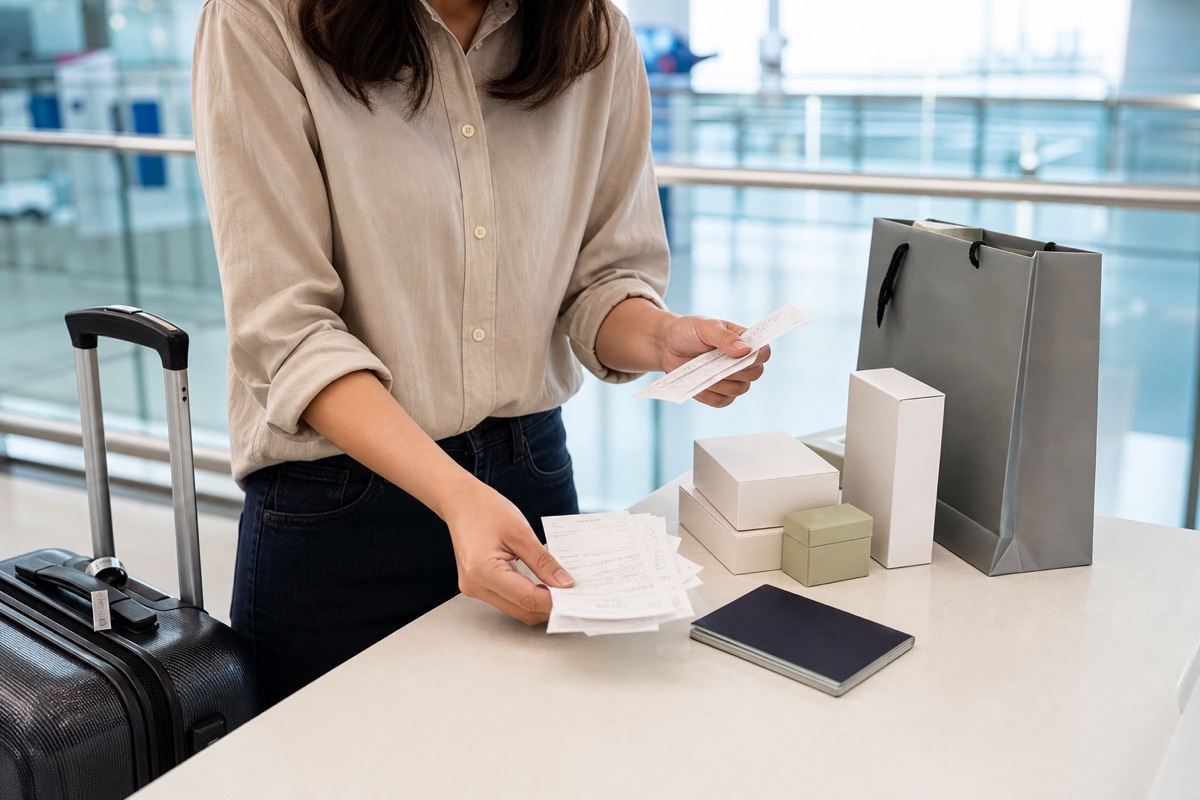
Korea Customs Service says outbound confirmation can require the passport, sales certificate or refund documentation, and the purchased goods in unopened and unused condition. At an airport with refund kiosks, travelers generally scan the passport and refund record; selected transactions are referred to customs inspection. Procedures vary by terminal and port.
- Passport and boarding information
- Refund receipts or electronic records
- The matching unopened, unused goods
- The payment card if the refund operator requires it
Do this before surrendering checked baggage when goods may need inspection. Allow extra time instead of treating a kiosk as guaranteed. Counter locations, opening hours, currencies and payment methods can change, and a machine may be unavailable.
Common ways a refund goes wrong
The product was opened
A visitor uses the cosmetic, removes packaging or gives the item away before departure. Customs can require goods to be unused and available for inspection.
The wrong receipt was kept
A card receipt alone may not contain the refund record. Check the document and refund operator before leaving the store.
The goods went into checked baggage too early
If customs selects the purchase for inspection after the suitcase has been checked, the visitor may be unable to present it. Complete the relevant departure steps first.
An old limit was used
Search results include older official pages with former thresholds. This guide uses the current KTO comprehensive guide and a 2026 Korea Customs Service overview; recheck them for later trips.
Frequently asked questions
Is every foreign visitor eligible?
No. Eligibility depends on residence, length and purpose of stay, and whether the visitor earns income in Korea. The purchase, store and export timing must also qualify.
Do I always need my physical passport at checkout?
Immediate-refund verification requires passport information, but accepted verification methods can differ by operator and store. Carrying the physical passport is the safest approach when planning a refund.
Can I use a product before leaving Korea?
Do not do so if the purchase relies on export verification. Official customs guidance says the goods may need to be presented unopened and unused.
Is the refund exactly 10%?
Do not budget on that assumption. The amount returned may be lower than the headline VAT rate because eligibility, tax composition and operator fees can affect the result.
Should I choose downtown or airport processing?
Choose based on the refund operator, your departure point and whether the goods require customs inspection. Downtown processing can save time, but it may still leave an export-confirmation step at departure.