Use three labels while watching
Documented tradition means an object, word or motif has a source outside the film. Creative adaptation means the filmmakers reshape a recognizable reference for character or story. Fictional lore means the movie creates its own rules. Keeping these labels visible prevents a stylish fantasy from becoming a false folklore lesson.
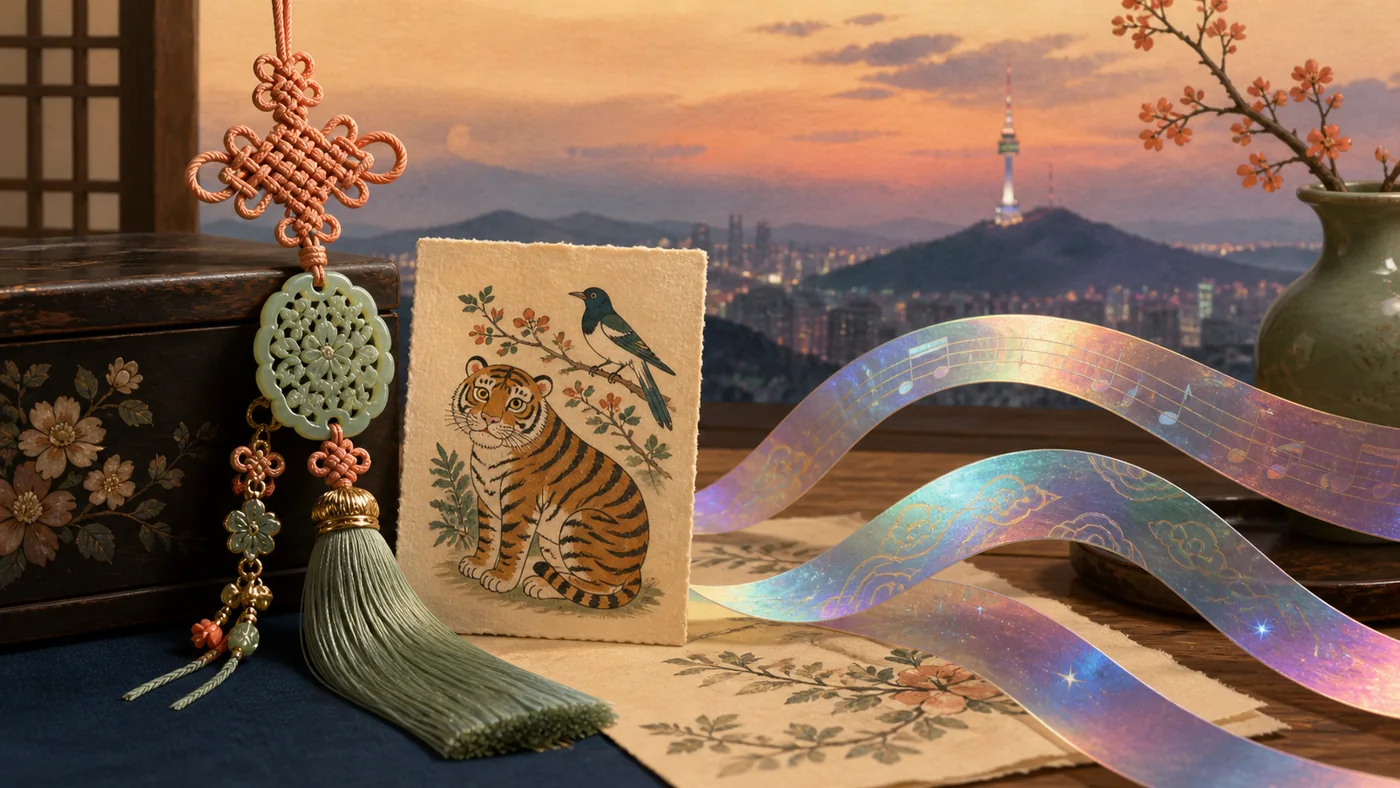
Norigae: a real ornament, individualized for the characters
Netflix's production coverage points to the trio's norigae when discussing their representative colors. The National Folk Museum of Korea describes norigae as traditional pendants and documents the decorative knotwork, embroidery and wishes for health or happiness connected with such objects.
That establishes a real material tradition. It does not mean the exact colors, powers or personality coding assigned to the characters are traditional rules. Those choices belong to the film's design team. If you visit a museum or shop, ask about material, knot, period and intended use rather than calling any tasselled accessory a “demon hunter charm.”
Tigers and magpies: familiar folk-art subjects, not a single fixed story
Korea.net's account of a traditional folk-painting exhibition explains one common reading of magpie-and-tiger imagery: magpies can deliver good news, while tigers prevent bad news. That context helps viewers recognize why an expressive tiger can feel culturally familiar.
Folk paintings vary by artist, period and purpose. Derpy and Sussie are film characters, not museum labels, and their relationship should not be presented as the definitive meaning of every Korean tiger-and-magpie painting. Use the connection as an invitation to look at minhwa, not as a one-to-one decoding key.
“Saja” works because Korean words can carry different meanings
The group name Saja Boys plays with Korean language. The National Institute of Korean Language lists saja (사자, 獅子) as “lion,” while a National Folk Museum curator's explanation places jeoseungsaja among figures that guide the dead on the road to the underworld. The film uses the shared romanized sound for a boy-band name that feels plausible before its darker role becomes clear.
The weapons combine reference and invention
Netflix identifies Rumi's weapon as a saingeom, or Four Tiger Sword, Mira's as a curved moon sword and Zoey's as spirit blades. Production commentary also explains that the artists treated the weapons as colorful musical energy rather than ordinary hard-edged metal.
The useful conclusion is not that historical Korean weapons behaved like the film's glowing blades. The names and shapes can reference Korean language and visual history, while the liquid-light movement, musical force and supernatural mechanics are animation design.
Honmoon and idol-powered demon hunting are movie lore
The Honmoon is central to the story's emotional and visual system. Netflix's design article explains how its color supports the film's themes, but that production explanation is evidence about the movie—not evidence of a historical Korean religious barrier with the same rules.
The same boundary applies to generations of idol demon hunters, soul-powered singing and the exact demon hierarchy. Enjoy them as a modern fantasy built with Korean creative input. Avoid telling travelers that they will find an official Honmoon ritual, HUNTR/X shrine or Saja Boys legend at a heritage site.
How to explore the culture respectfully in Seoul
Start with institutions and public places rather than attempting to recreate scenes in working religious spaces or residential alleys. The National Folk Museum of Korea provides context for dress, domestic life and folk culture. Museum labels are a better authority for an artifact than merchandise copy or a fan theory.
For a location-focused day, use Koursea's real Seoul places guide, which distinguishes visitable landmarks from animated settings. For awards, sequel and concert claims, use the separate official timeline.
Official sources checked
- Netflix Tudum: How Colors Tell the Story — production design, norigae and weapon terminology.
- Netflix Tudum: film, songs and lore overview — official story context.
- National Folk Museum of Korea: maedeup exhibition — traditional knotting and norigae context.
- National Folk Museum Korean Culture Box — embroidery, ornaments and household context.
- Korea.net: magpie-and-tiger folk painting — an official cultural explanation of the motif.
- National Institute of Korean Language: 사자 — the lion sense of the word.
- National Folk Museum curator: funeral-bier figures — jeoseungsaja as an underworld-guide figure.