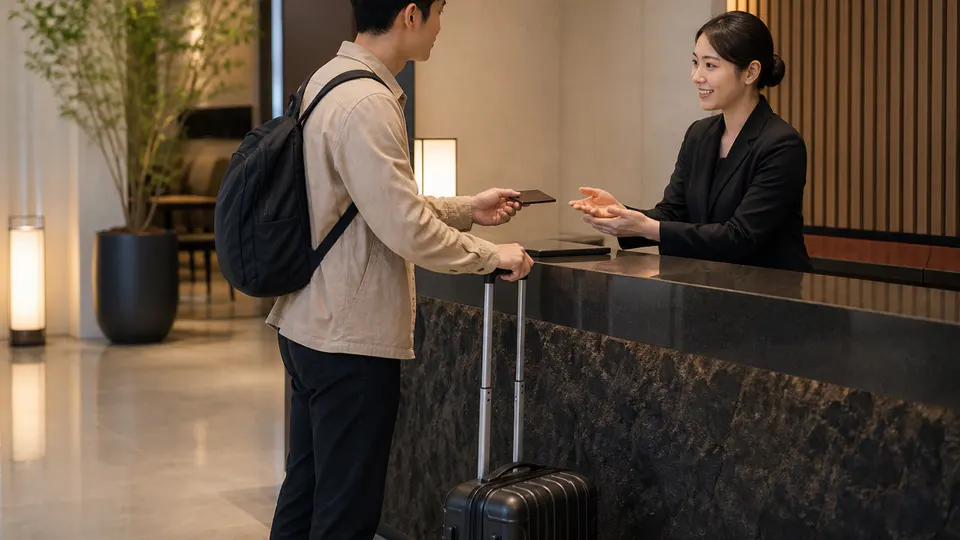
Goshiwon in Korea: a safety and booking checklist for foreign visitors
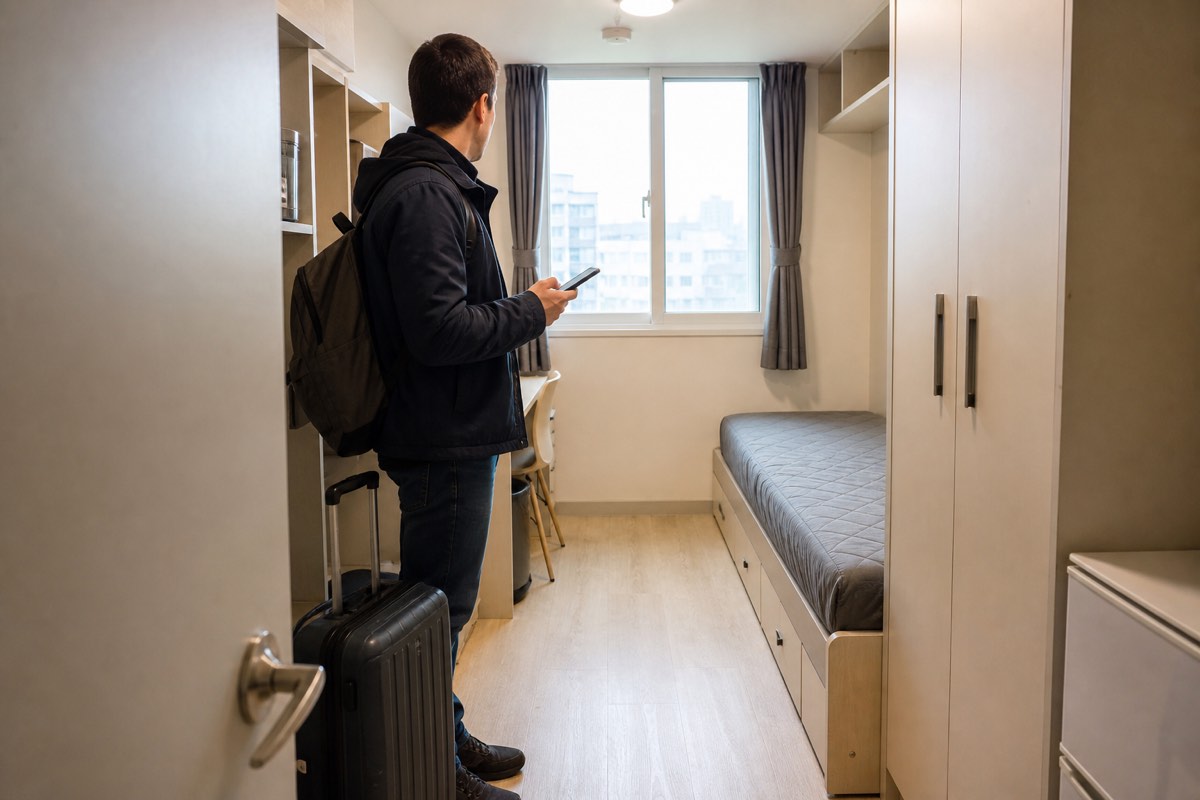
Goshiwon, goshitel and one-room-tel are marketing labels
Listings use terms such as goshiwon, goshitel and one-room-tel inconsistently. One property may offer a bed and desk with shared bathroom; another may include a private shower, toilet, refrigerator and exterior window. “One room” does not guarantee the size or facilities of a studio apartment.
Ask for the usable room area, private or shared bathroom, exterior window, air-conditioning arrangement, heating, kitchen access, laundry, elevator and luggage storage in writing. Request current images of the exact room type, not only the renovated sample room.
Inspect the exact room, not the category
- Open and close the room door and window; check the lock, privacy and whether the window faces outdoors or an internal shaft.
- Run the shower and sink, flush the toilet if private, and look for active leaks, mold odor or poor drainage.
- Stand quietly with the ventilation and refrigerator running to judge noise from equipment, corridors and neighboring rooms.
- Confirm where luggage fits without blocking the exit and whether the desk can support your actual study or work setup.
- Walk from the room to the street by the normal route and the emergency route. Check stairs, elevator access and locked doors.
If you cannot inspect in person, request a live video call that starts outside the building, shows the room number or identifiable corridor, and demonstrates the exact facilities. A video reduces uncertainty but does not replace written terms or prove future availability.
Who might consider it
- A student, language learner or solo visitor staying several weeks.
- A person who values a private sleeping space more than a hostel lounge.
- A traveler with a simple routine and very little luggage.
- Someone who has inspected the building or can cancel after seeing the real room.
A couple, family, light sleeper, remote worker needing calls, traveler with large luggage or anyone requiring step-free space may find the format difficult. Gender-exclusive floors or entire buildings also exist; confirm whether a listing is women-only, men-only or mixed.
Short stays are not automatically available
Some properties advertise daily or weekly stays, while others require a month or longer. Confirm minimum stay, move-in time, payment schedule, deposit, cleaning fee, utility charge, cancellation rule and whether the quoted price includes bedding. Do not assume a residential-looking listing can legally or operationally function like a hotel for one night.
Verify the operator before sending money
Match the payee, operator name, phone number and building address across the listing and written agreement. Ask who can issue the receipt and who holds the deposit. Be cautious when the contact refuses a viewing, changes the bank account at the last moment, requests cryptocurrency or gift cards, or promises a special room that cannot be identified.
Pay only the amount and schedule stated in writing. A small reservation payment can still be non-refundable, so obtain the cancellation trigger and refund date first. Do not send passport scans through an informal chat merely to “hold” a room; ask why each identity field is needed and use the operator's established process.
Fire and evacuation checks are essential
Seoul Metropolitan Government has identified goshiwon among building types requiring attention in fire-safety inspections. That does not mean every property is unsafe. It means a tiny room and unfamiliar corridor make personal verification important.
After moving in, keep the floor plan in mind, avoid unsafe cooking devices, do not overload adapters and keep the route to the exit clear. Call 119 for fire or medical emergency.
Ventilation, hygiene and shared-space checks
An exterior window, mechanical vent and air conditioner perform different jobs. Ask whether ventilation is controllable from the room and who cleans filters. In shared bathrooms and kitchens, inspect the cleaning schedule, food-storage labels, pest controls and whether wet floors create a slip risk. Persistent dampness, sewage odor or visible spreading mold deserves clarification before payment.
Confirm how bedding is provided and laundered, where trash and recycling go, and whether laundry drying blocks corridors. Photograph existing stains, cracks, appliance damage and bathroom condition at move-in. Send the dated record to the operator so it cannot later be mistaken for damage you caused.
Contract and payment checklist
- Confirm the real operator and exact building address.
- Get the price, deposit, included utilities and refund conditions in writing.
- Ask whether early departure loses prepaid rent or deposit.
- Record the room condition at move-in.
- Receive proof of every payment.
- Do not send a large deposit only because a social account claims scarcity.
- For a longer or higher-value rental, seek multilingual housing-contract assistance.
Seoul operates designated global real-estate agencies that explain deposits and contract terms in several languages for registered foreign residents. A goshiwon arrangement may not use the same process as a standard apartment lease, but the official service is a useful escalation path when the agreement resembles a residential rental or the deposit is significant.
Address registration, mail and visitors
If you need residence reporting, banking mail, school paperwork or immigration documents, ask whether the property permits and supports the required address use before paying. Koursea cannot determine eligibility from a listing name; requirements depend on your status, document and the property's arrangement.
Also confirm curfew, guest policy, parcel delivery, shared-kitchen hours, cleaning duties, food storage and quiet hours. A rule that seems minor on day one can dominate a month-long stay.
Prepare the move-out before moving in
Put the notice period, checkout time, cleaning expectation, key return and deposit-return method in the agreement. Before leaving, photograph the cleared room, return access items with a written acknowledgment and request an itemized explanation for any deduction. Keep payment records and messages until the deposit is resolved.
If the operator and resident disagree, preserve evidence and seek an appropriate multilingual housing or legal-information channel; do not threaten public exposure or enter restricted areas to recover property. Emergency danger belongs with 112 or 119, while ordinary contract disputes require a different process.
What residents may appreciate—and find difficult
Possible strengths: privacy compared with a dorm, simple monthly cost and locations near universities or transit. Recurring trade-offs: very small rooms, noise, limited ventilation, shared facilities and inconsistent English communication. These are category patterns, not claims about every property.
Goshiwon questions visitors ask
What is a goshiwon in Korea?
It is a compact private-room accommodation category, not one standardized room type. Bathrooms, windows, refrigerators, kitchens and laundry arrangements vary, so compare the exact room rather than the label.
Are gosiwon and goshiwon the same thing?
Usually, yes. Gosiwon and goshiwon are alternate English spellings of the Korean word 고시원. Listings may also use goshitel or one-room-tel, but those labels do not guarantee particular room facilities.
Can foreign visitors book a goshiwon?
Some operators accept foreign visitors, but minimum stays, payment methods, identification, address use and language support vary. Confirm the room, full terms and operator identity in writing before paying.
Can you stay in a goshiwon for one night?
Not automatically. Some properties offer daily or weekly stays, while others require a month or longer. Confirm the minimum stay, move-in time, bedding, fees, cancellation terms and whether the property can operate as short-stay accommodation.
What should you check before paying?
Verify the exact room, exterior window, bathroom, ventilation, luggage fit, evacuation route, operator identity, total fees, refund conditions and deposit-return process. Obtain the terms and proof of every payment in writing.