Power banks on flights from Korea: carry-on, capacity and storage rules
The quick decision
| Battery rating | Current baseline | Action |
|---|---|---|
| 100Wh or below | Carry-on only; up to two power banks | Protect each separately and confirm the operating carrier |
| Over 100Wh through 160Wh | Airline approval required; up to two | Contact the carrier before travel |
| Over 160Wh | Not accepted as passenger baggage | Leave it out of the trip |
| Rating missing or unreadable | Capacity cannot be verified; transport may be refused | Find exact manufacturer documentation or do not pack it |
This table covers consumer power banks. Installed batteries, spare camera batteries, mobility equipment, medical devices and smart luggage can follow different rules.
Carry-on only also applies at the gate
A power bank is a spare lithium battery. Keep it with you through the baggage process. If staff gate-check your cabin bag, remove the power bank before handing the bag over. A padded case or switched-off state does not make it acceptable in the aircraft hold.
The operating airline has final acceptance authority and a route or connection can add restrictions. On a codeshare ticket, look for “operated by” and check that carrier for every segment.
Find the Wh rating
Look for Wh on the battery, packaging or exact-model manual. If the manufacturer provides milliamp-hours and voltage, calculate:
A 15,000mAh battery rated at 3.7V is 55.5Wh. Do not substitute the USB output voltage or guess from a similar product.
Photograph the label before travel. Korean Air warns that a product without enough information to establish capacity may be refused.
The two-unit rule
Incheon Airport's current English restricted-items page states that power banks under 160Wh are limited to two per passenger, with airline approval between 100Wh and 160Wh. Korean Air and Asiana publish the same two-power-bank ceiling under rules effective April 20, 2026.
Older screenshots may show different allowances. Use the live airport and operating-carrier pages, not an old packing graphic or marketplace listing.
Protect each battery separately
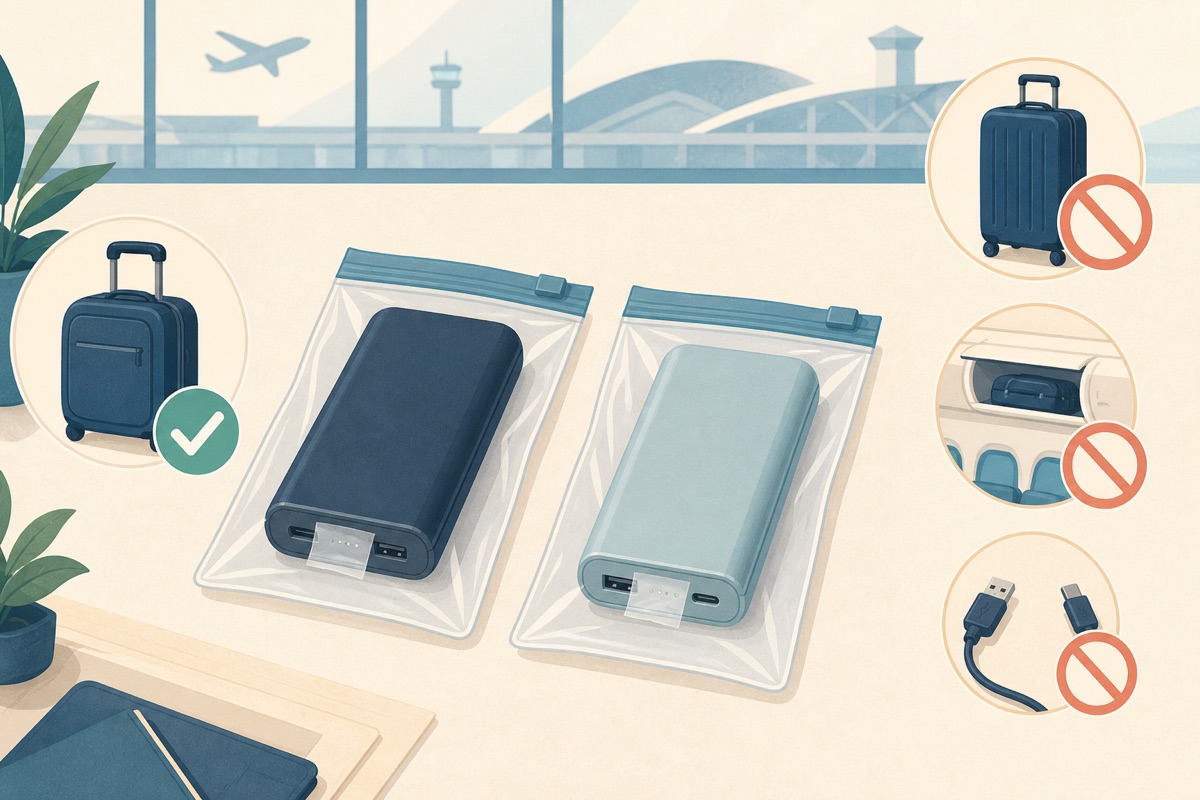
Prevent terminals from touching metal or another battery. Cover exposed terminals with insulating tape, place each battery in its own zipper bag, or use an individual pouch or fitted cap. One bag per battery matters: two loose units with keys and coins in one pouch are not isolated.
Disconnect charging cables and protect the power button from pressure. Tape is for preventing contact, not disguising a swollen or damaged cell.
Accessible on board, but not in use
Under the cited April 20 rules, do not place a power bank in the overhead bin. Korean Air and Asiana direct passengers to keep it with them or in an accessible seat pocket, subject to cabin-crew instructions. Do not wedge it into a seat mechanism; if it falls into a seat gap, alert crew rather than moving the seat.
Do not use a power bank to charge another device in flight, and do not charge the power bank itself. Charge before boarding and follow the airline's instructions for aircraft-provided power.
Damaged, swollen or hot batteries
Before-you-go checklist
- Confirm the operating carrier for every flight segment.
- Find and photograph the printed Wh rating.
- Obtain advance approval for a unit over 100Wh through 160Wh.
- Pack no more than the carrier's current allowance.
- Carry power banks in the cabin and remove them before gate-checking a bag.
- Protect each unit separately against short circuits.
- Keep batteries accessible, out of the overhead bin, and unused in flight.
- Leave damaged or capacity-unverifiable batteries behind.
Official sources
- Incheon International Airport: Restricted Items — rechecked August 25, 2026
- Incheon International Airport: Restricted Items FAQ — rechecked August 25, 2026
- Korean Air: power-bank guide effective April 20, 2026 — rechecked August 25, 2026
- Korean Air: Restricted items — rechecked August 25, 2026
- Asiana: power-bank carry-on and storage rules — rechecked August 25, 2026