Korea power plugs and voltage: do you need an adapter or converter?
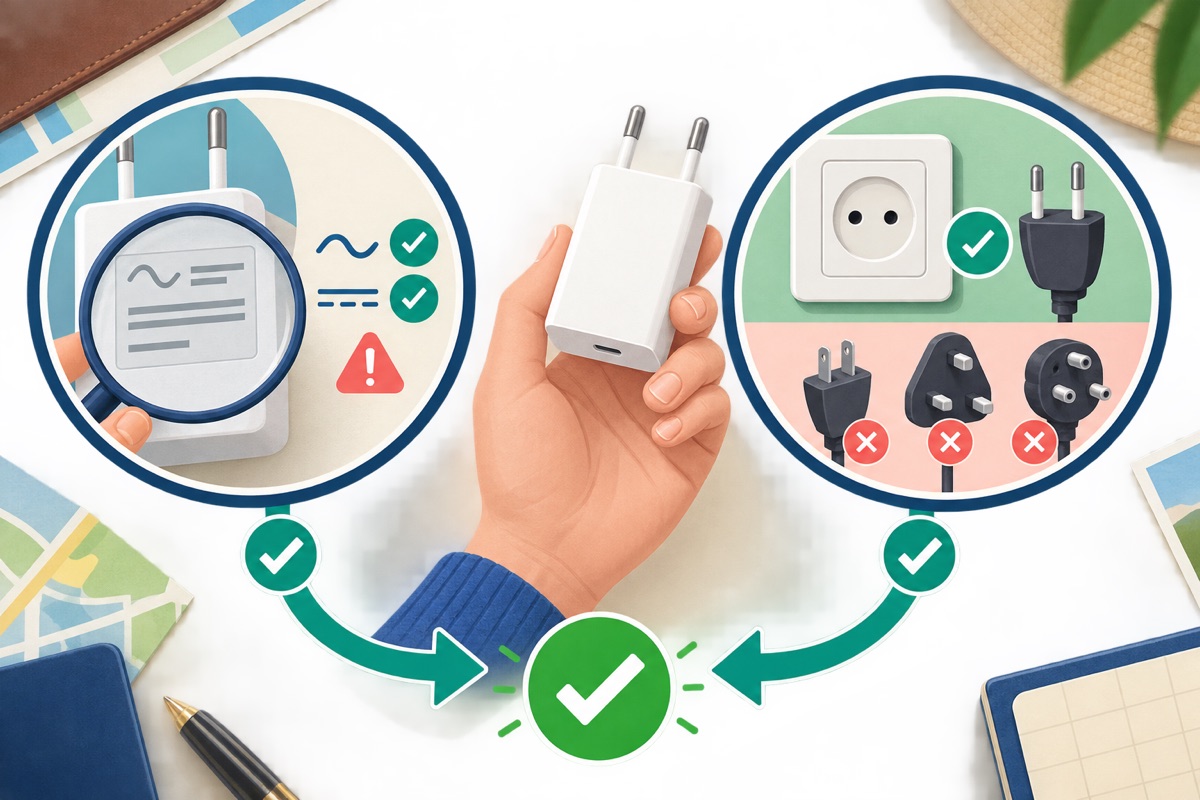
INPUT label on every device or charger. A plug adapter changes the physical connection; unless its instructions explicitly say otherwise, it does not change voltage.The quick decision
| What you find | What it means | Next step |
|---|---|---|
| The plug fits, and the input label includes 220V and 60Hz | The device may fit and accept Korea's supply | Confirm the full label and manufacturer instructions |
| The input label includes 220V and 60Hz, but the plug does not fit | The electrical input may be compatible while the physical plug is not | Use a suitable, traceable plug adapter rated for the load |
| The label does not include 220V, or is missing or unclear | Compatibility is not established | Check the exact model's manufacturer manual before connecting it |
| The equipment has a grounded plug, high power draw, heat or a motor | Plug shape alone cannot establish safe use | Confirm grounding, load and frequency requirements separately |
These are checking steps, not universal product promises. Similar-looking chargers can have different input limits, and regional or replacement versions of the same product may differ.
Korea's outlet standard
The Korea Tourism Organization states that Korea's standard supply is 220V at 60Hz and describes the outlet as having two round holes. These are commonly identified as Type C and Type F-style outlets. Use that baseline when reading the equipment you will actually pack.
Do not decide from a country list on adapter packaging alone. The adapter must fit the actual outlet, the connected device still has to accept the electrical supply, and any required grounding must remain effective.
Adapter versus converter
A plug adapter changes the connection
A plug adapter provides a physical connection between your plug and the Korean outlet. Treat it as not changing voltage or frequency unless its own documentation explicitly says it performs conversion. Its current, voltage and load ratings must still suit the connected equipment.
A converter or transformer changes voltage
A voltage converter or transformer is intended to change electrical voltage for equipment designed for another supply. The correct choice depends on the device's power, operating time and manufacturer requirements. Heating appliances, motors, mobility equipment and sensitive devices may have requirements that a phone charger does not.
The U.S. Department of State advises travelers to compare destination voltage and plug/outlet type with their equipment, noting that a converter and an adapter solve different problems. Use that as a decision framework; the manufacturer remains the authority for a specific model.
How to read the charger label
Look on the power brick, detachable charger, device base or manual for a line labeled INPUT. You are checking whether the stated range covers Korea's 220V supply and 60Hz frequency.
A broad multi-voltage range may cover Korea, while a single lower voltage may not. Never copy a sample range from another traveler's charger: inspect the unit you will use.
Phones, laptops and USB devices
Many modern phone and laptop chargers work across more than one national power system, but “many” is not a compatibility guarantee. Read the label. When the charger accepts Korea's supply, the remaining issue may be only the plug connection.
Inspect cables, pins and power bricks for cracks, heat damage or exposed conductors. Stop using equipment that becomes unusually hot, smells burnt, sparks or sits loosely in the outlet. Do not stabilize a loose connection with tape or another object.
USB ports in a hotel, airport or vehicle are conveniences, not universal power promises. Charging speed, connector type and availability vary. A cable alone does not solve the wall-plug decision if your own charger is still required.
Hair dryers, straighteners and heat appliances
Hair dryers, irons, steamers, kettles and styling tools often draw much more power than a phone charger. Never use one merely because an adapter makes its plug fit. Confirm input voltage, frequency, wattage and any dual-voltage selector instructions.
If your accommodation provides the appliance, that is often simpler. Ask before packing. If a device has a manual voltage switch, follow its manufacturer instructions exactly and change the setting only while unplugged.
Medical and mobility equipment
For CPAP machines, nebulizers, mobility-equipment chargers, refrigerated-medicine systems or other essential devices, do not rely on a general travel guide. Give the manufacturer or equipment provider Korea's 220V/60Hz standard and ask about the exact model, power supply, grounding and backup plan.
Carry approved cables and any appropriate spare or battery. Check airline rules separately for lithium batteries. When power is essential, identify a repair or replacement route before departure; an airport shop is not an adequate medical-equipment contingency.
Where to find an adapter or charging fallback
VISITKOREA says travelers may ask a hotel front desk about borrowing or purchasing an adapter and may find adapters at airports, retail stores, major duty-free shops and convenience stores. Treat each as a possible fallback, not an inventory guarantee. Ask the first accommodation before arrival if charging on night one matters.
Incheon International Airport says it has passenger charging facilities with 110V, 220V and USB in terminal check-in and departure areas, arrival areas and the concourse. This does not mean every gate or seat has every connector. Recheck the airport page when a particular location matters.
Adapter safety matters
“Universal” is a format claim, not proof of safe construction. Government product-safety agencies have recalled travel adapters for inadequate shutters, accessible live parts and grounding problems. That does not mean all universal adapters are unsafe; it supports choosing a traceable product with clear ratings, instructions and compliance information for the market where it was sold.
Packing checklist
- Photograph the
INPUTlabel on every charger and essential device. - Confirm that the label or manufacturer manual covers 220V and 60Hz.
- Compare your plug with Korea's two-round-hole outlet.
- Choose a rated, traceable adapter that preserves required grounding.
- Check heat, motor, medical and mobility equipment separately.
- Ask your first accommodation whether it lends adapters or provides the appliance.
- Recheck airline rules for spare batteries and power banks.
Official sources
- VISITKOREA: Electricity & Communications — last updated August 21, 2025; rechecked August 25, 2026
- Incheon International Airport: Frequently Asked Questions — rechecked August 25, 2026
- U.S. Department of State: Accessibility Needs
- UK Office for Product Safety and Standards: universal adapter recall example