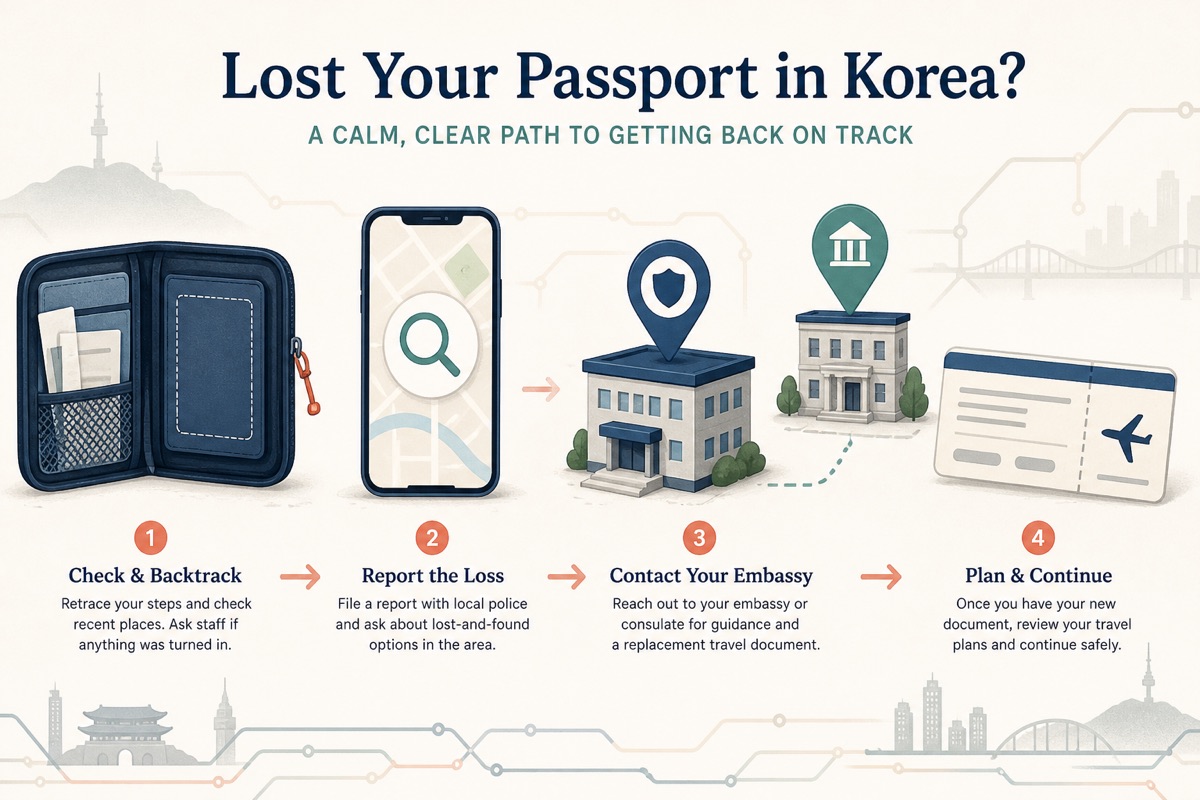
The recovery sequence
Freeze the timeline and backtrack
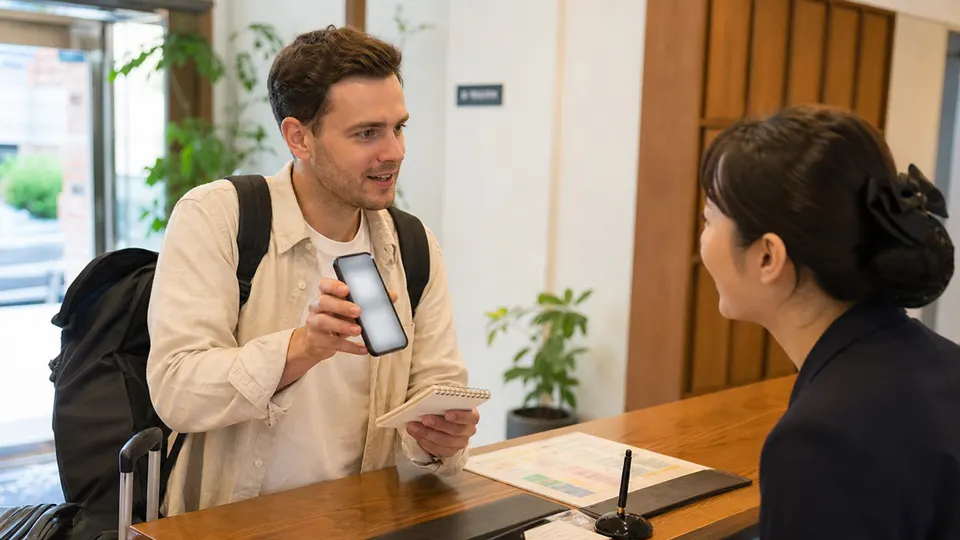
Write down the last confirmed sighting, not only the moment you noticed the loss. Check the hotel safe, check-in desk, tax-refund counter, SIM desk, bank or currency booth, airport security tray, train seat, taxi, locker and recent shop. Ask staff for the correct lost-property channel and record the branch, terminal, vehicle, seat, time and item description. If the loss happened at ICN, use the Incheon baggage and lost-property routing guide to separate aircraft, terminal, bus and rail responsibility.
Search LOST112, the Korean National Police Agency's integrated lost-property portal. Police guidance says the service includes items handled by police and participating public or private operators. A search result still needs identity and ownership checks before collection.
Decide whether to report now
When theft is suspected, departure is close, or the passport cannot be located after focused backtracking, ask local police how to make the appropriate report. Keep the report number or document and the station's contact details. Your embassy may request police documentation, but the exact requirement depends on your nationality and consular procedure.
Do not file a theft story merely because you need paperwork quickly. Also do not keep travelling indefinitely on the hope that a passport will appear. Balance a short, targeted search against embassy hours, weekends, public holidays and your flight deadline.
Contact your own embassy or consulate
Your government—not Koursea, the Korean police or a hotel—decides what replacement or emergency travel document it can issue. Use your embassy's official website or phone number and ask about an appointment, police report, passport copy, other identification, photos, fees, proof of travel, processing time and whether the document is valid for transit countries.
Korea's Ministry of Foreign Affairs maintains an official directory of foreign missions in the Republic of Korea. Use it to find the mission, then confirm emergency instructions on that mission's own current page. If your country has no resident mission, ask the accredited embassy which location handles your case.
Separate the document problem from Korean status questions
A replacement passport does not automatically answer every immigration or airline question. Short-term visitors, visa holders and foreign residents may have different records or follow-up steps. Call the Korea Immigration Contact Center at 1345 for Korean entry, stay or departure questions; police list 1345 as the immigration help contact for foreigners.
Ask a narrow question: whether your Korean immigration record requires an update, whether a lost visa label matters, or what document is needed at departure. Do not assume online anecdotes for another nationality, visa class or year apply to you.
Change the flight only after the issuing path is clear
Tell the airline that the travel document is being replaced, but do not rely on airline staff to predict embassy processing. Check whether the new document will be accepted for your destination and every transit point. A direct flight may avoid a transit-document problem, but only the relevant authorities and carrier can confirm acceptance.
Compare the cost of changing the ticket with the risk of missing it. Keep accommodation, medication, connectivity and payment available for a delay. If cards or a phone were lost with the passport, handle account security separately rather than exposing full document details in public messages.
What to prepare before calling
- Full name, nationality, date of birth and a safe callback method
- Passport number or a secure copy, if available
- Last confirmed location and time; police report details if already filed
- Other photo identification and proof of citizenship requested by your embassy
- Current accommodation address and remaining Korean stay
- Flight date, route and transit countries
- A payment and photo plan that follows the mission's instructions
Keep copies in a secure account rather than a public photo album or group chat. Share only what the police, embassy, immigration authority or carrier actually requests through an official channel.
Common mistakes that create a second problem
- Booking a new flight before learning the document timeline. Embassy closures and nationality-specific checks can make a same-day assumption expensive.
- Treating a LOST112 listing as collection approval. The custodian may require a matching description and identity evidence.
- Using an invalidated passport after it is found. Once your issuing authority records a passport as lost or cancelled, ask that authority whether it can ever be used again; do not guess.
- Posting the passport number publicly. Give identifying information only through official reporting and consular channels.
- Assuming the police report permits travel. It documents the incident; it is not a passport or an airline boarding authorization.
If language is the immediate blocker
The Korean National Police Agency lists 112 for crime reports, 1330 for foreign tourist information and 1345 for immigration assistance. VISITKOREA describes 1330 as a multilingual travel-information and interpretation service with phone and online channels. Use Koursea's translation-help guide to prepare the route, time and item description before calling. For a non-urgent lost item, ask whether the venue, transport operator or LOST112 should handle the first search.
Official sources checked
- Korean National Police Agency: LOST112 guidance — integrated lost-property search and reporting.
- Korean National Police Agency English contact page — 112, 1330 and 1345 contact roles.
- VISITKOREA: 1330 Travel Helpline — tourist information, interpretation and complaint channels.
- Korean Ministry of Foreign Affairs: foreign missions in Korea — embassy and consulate directory.