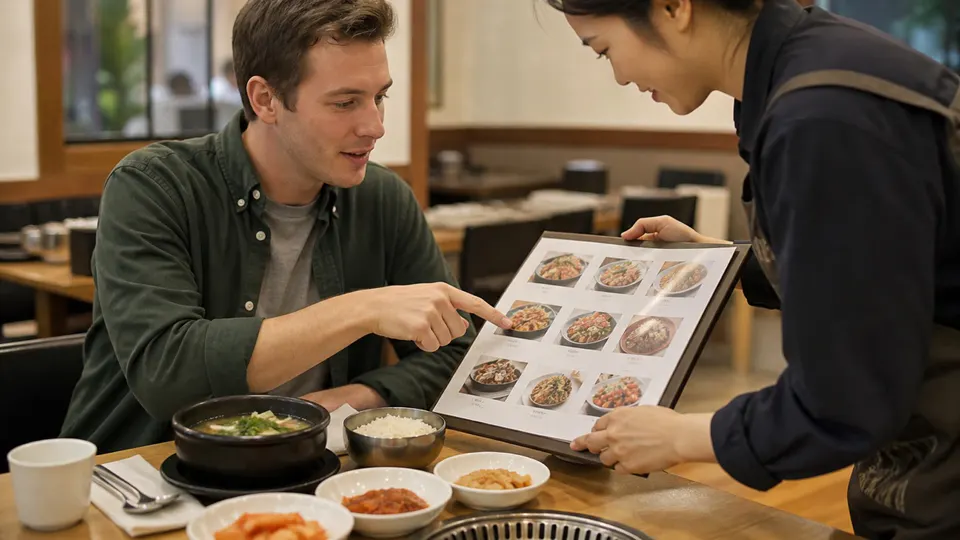
Find the hidden cutlery drawer
Many casual Korean restaurants store stainless-steel spoons, chopsticks, napkins, or bottle openers in a shallow drawer under the tabletop or along one side. Look before assuming the table was not set. Some restaurants still use a covered container on top, while self-service shops may keep utensils beside the water station. Take only what your table needs.
Use the table bell naturally
A small button marked 호출, 벨, or simply a bell icon is an ordinary way to request staff attention. Press it once and wait; repeated ringing is unnecessary. In restaurants without a bell, a polite “Jeogiyo” (저기요) is acceptable. Do not whistle, snap fingers, or shout across the room. Tablet ordering and QR menus are increasingly common, but a staff member can usually help if payment or language settings fail.
Water, banchan and the self-service bar
Signs reading 물은 셀프 mean water is self-service. Basic banchan is normally included and refills are commonly free, but refill method varies: use a clearly marked self bar or point to the empty dish and ask “이거 좀 더 주세요.” Do not take food from an unmarked kitchen counter. Return trays only where the restaurant indicates.
One-person menus and solo dining
“One menu per person” is a common minimum, and barbecue, dakgalbi, hotpot, or shared set menus may require two portions even for one diner. Before sitting, ask whether one person can order: 혼자 먹을 수 있어요? Choose gukbap, noodles, rice bowls, kimbap, or restaurants displaying 혼밥 when shared-dish minimums make solo service impractical. Menu prices usually include VAT, and tipping is not expected at standard restaurants.
Show this Korean card
혼자 먹을 수 있어요? 물과 반찬은 어디에서 가져오면 되나요?
Official sources
Time-sensitive details were checked against the original sources below on 2026-08-30.