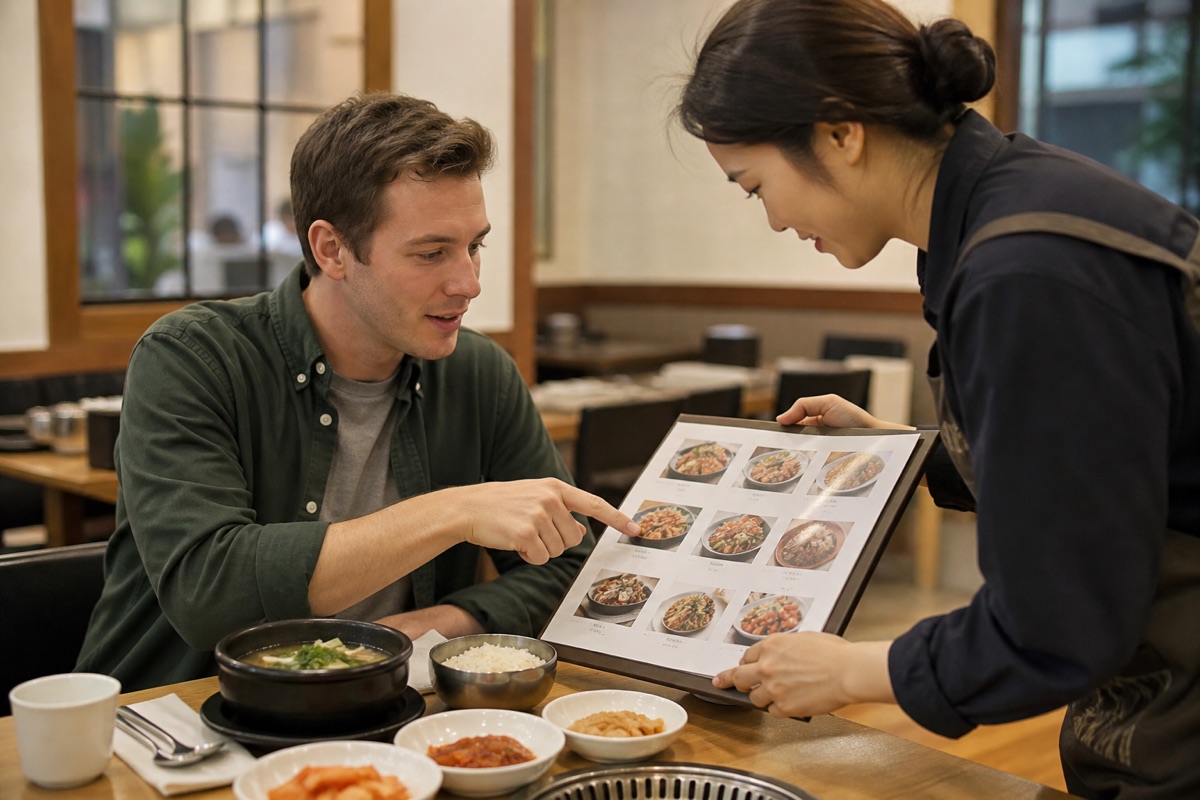
- Key point: Match the menu item, portion count and table minimum before ordering, then confirm spice or dietary needs separately.
- Price: Check whether rice, drinks, side dishes, service items or additional portions are included or charged.
- Tip: Point to the exact menu line, repeat the quantity and keep a translation phrase ready for clarification.
Before you sit down
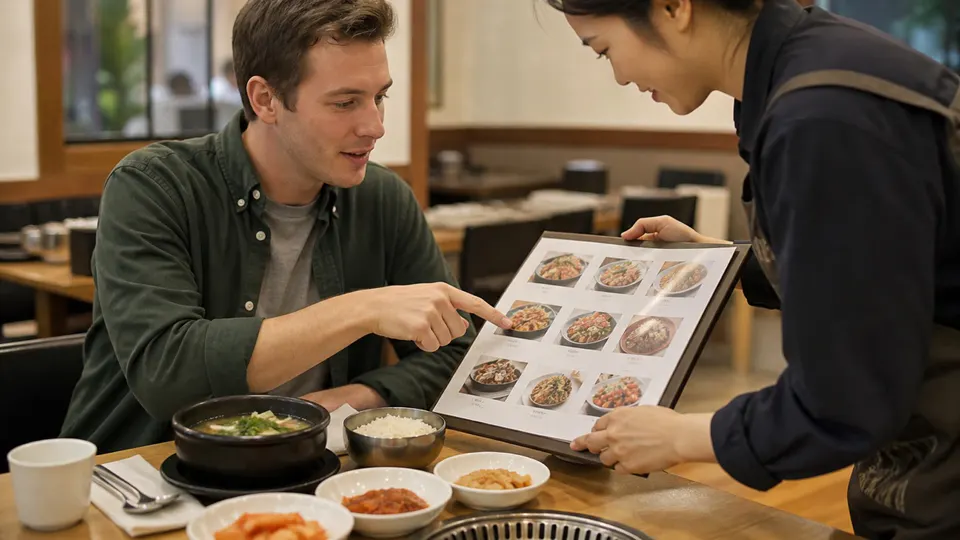
Look for a menu or price board before committing. Some restaurants specialize in one dish, require a minimum order for barbecue, or price food per person. A queue machine may ask for a Korean phone number; if it does, show the screen to staff rather than inventing one. Shoes normally stay on, but a traditional floor-seating room may ask you to remove them.
Four common ordering systems
1. Order with a server
Pointing to the Korean menu, a photo, or a saved translation is normal. State the quantity clearly. If a table call button is present, use it when you are ready; Korea Tourism Organization notes that call buttons are common.
2. Table tablet
Many restaurants use a tablet fixed to the table. Check for a language button, review the quantity, and look for a final confirmation screen. The tablet may also include a button to call staff or request extra items.
3. Self-service kiosk
Select dine-in or takeaway, choose the dish and options, then pay. Overseas cards occasionally fail at unattended terminals even when the restaurant accepts cards at a staffed counter. Ask for help rather than submitting the same payment repeatedly.
4. Counter first
At cafés, noodle shops, food courts, and quick-service restaurants, you may order and pay before sitting. Keep the receipt or buzzer and listen for your number.
Check whether the dish is individual or shared
A bowl of noodles or bibimbap is usually an individual meal. Barbecue, hot pot, large stews, fried chicken, and set menus may be designed for two or more people. The menu may show a minimum quantity, such as two portions of meat. Do not assume the number beside a dish is its serving count; it may be weight, size, or quantity.
If you are dining alone, search for honbap (혼밥) options or ask whether a one-person order is possible. A refusal is often about the kitchen format or table minimum, not the visitor.
Banchan, water, and utensils
Small side dishes called banchan often arrive with a Korean meal. Korea Tourism Organization explains that water and extra side dishes are commonly provided without an additional charge, although a special or separately listed side dish can still be paid. Some restaurants direct guests to a self-service station. Check the sign before assuming a refill is table service.
Spoons, chopsticks, and napkins may be in a drawer under the table. At barbecue restaurants, staff may cook the meat or may expect diners to do it; watch the first interaction and ask if unsure.
Dietary needs require ingredient-level confirmation
A dish that looks vegetarian may contain anchovy stock, meat broth, fish sauce, egg, or garnish. Korea Tourism Organization advises vegetarian travelers to explain exactly which ingredients must be excluded. The same principle applies to allergies and religious requirements.
Do not treat an English menu, a foreign-language review, or the word “pork-free” as proof of halal certification, vegan preparation, or protection from cross-contact. Show a written ingredient list, name the allergen, and ask whether the kitchen can accommodate it. If the consequence of an error is serious, choose a restaurant with clear official information and direct confirmation.
Paying and tipping
At many sit-down restaurants, take the bill or simply go to the cashier near the entrance when finished. Others use the table tablet or a payment kiosk. Korea Tourism Organization states that tipping is not required or expected in Korea. A service fee can exist in a special venue or booking product, so rely on the stated total rather than adding an informal tip.
Keep a second payment method available. If an overseas card fails, ask whether the cashier has another terminal before assuming the card is unusable everywhere.
Useful phrases to show or say
Jumunhalgeyo
We’d like to order.
Igeo hana juseyo
One of this, please.
An maeun geollo juseyo
Please make it non-spicy.
Pojanghae juseyo
Takeaway, please.
Gyesanhalgeyo
We’d like to pay.
I jaeryoga deureogayo?
Does it contain this ingredient?
Machine translation is useful for ordinary ordering, but it should not be the only safeguard for a severe allergy. Keep the ingredient name in Korean and show it before ordering.