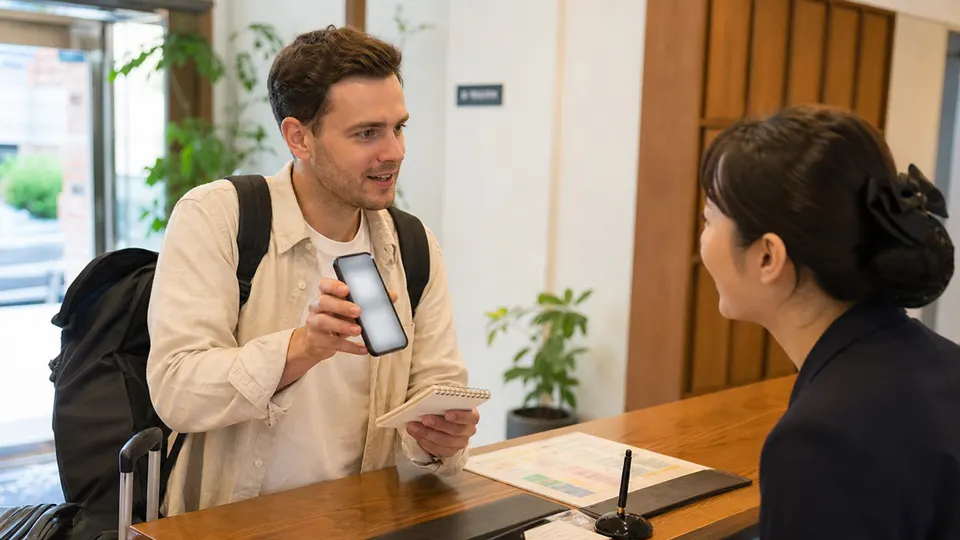
Translation help in Korea: apps, 1330 and emergency calls
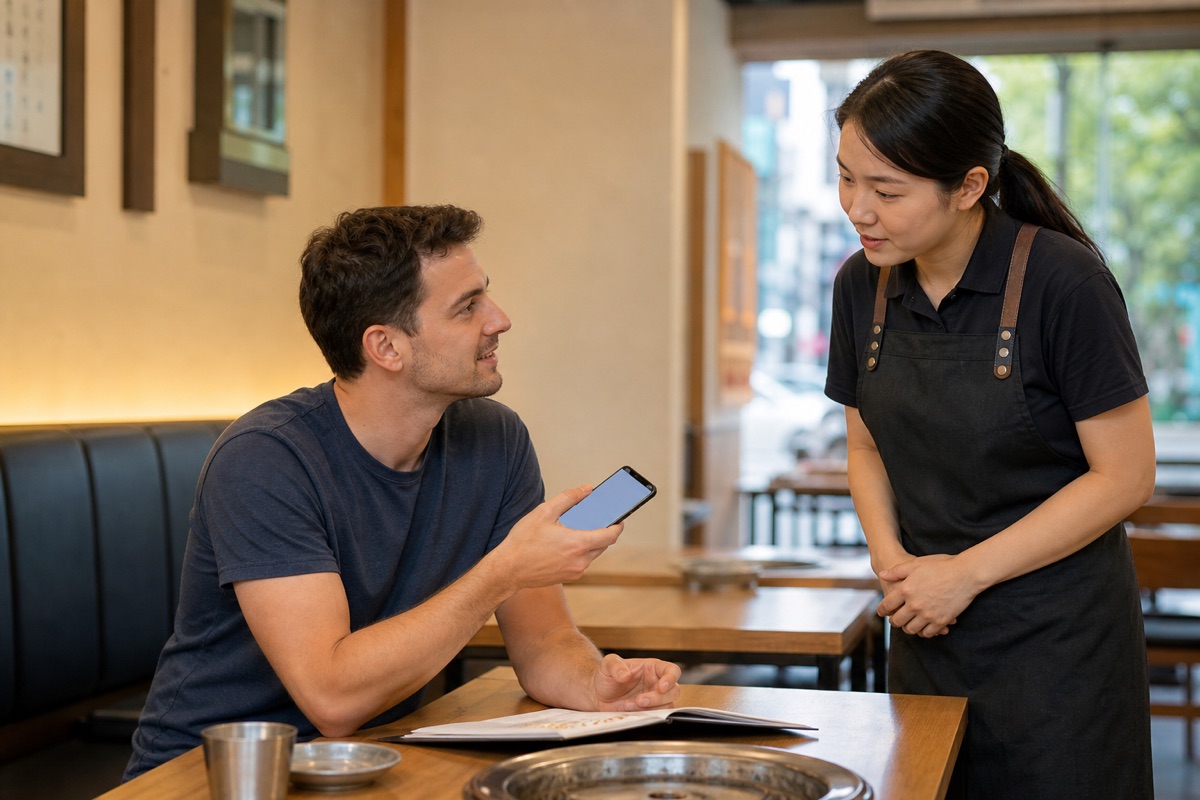
Pick the right translation layer
- Routine question: type one short sentence into a translation app.
- Address or reservation: show saved Korean text without retyping names or numbers.
- Travel-service problem: use 1330 when interpretation and visitor information are needed.
- Immediate danger: contact the appropriate emergency service first and state the location.
After any important translation, ask the other person to confirm the date, price, destination or action separately. A fluent-looking paragraph can still hide one consequential error.
Before leaving airport Wi-Fi
- Install your preferred translation app and download Korean offline support if available.
- Save your hotel name, full Korean address and phone number as text and screenshots.
- Store allergies, medication names and emergency contacts in both English and Korean.
- Save 1330, 112 and 119 in your notes rather than relying on memory.
- Test your eSIM or SIM before leaving the terminal.
When machine translation is enough
Apps work well for showing a destination, reading a simple menu, confirming a price or asking where a station exit is. Keep sentences short and literal. Translate one idea at a time, then show the result rather than reading uncertain pronunciation aloud.
Camera translation can miss handwritten menus, stylized fonts and small conditions. For money, allergies, dates and cancellation rules, ask the other person to type the answer and translate it back. A two-way check is safer than assuming the first output is correct.
When to use 1330
The Korea Travel Helpline handles visitor information, travel interpretation and tourism complaints by phone and chat. From inside Korea dial 1330; the official international number is +82-2-1330. VisitKorea currently lists Korean, English, Japanese, Chinese, Russian, Vietnamese, Thai and Indonesian among telephone languages, with current language availability shown on its service page.
Useful situations include clarifying transport information, explaining a non-emergency problem to accommodation staff, or asking where to seek official tourism help. The web chat can be valuable when speaking is difficult and preserves written context.
Interpretation does not grant authority
An interpreter can relay what each side says, but cannot approve a refund, waive a hotel rule, diagnose a condition or guarantee an ingredient. Identify who has decision-making authority—the operator, merchant, accommodation, police or medical professional—and use interpretation to ask that person a precise question. Save the final answer in the official booking, receipt or case channel when the outcome matters.
Before calling, write the organization name, Korean address, date, amount and desired factual outcome. This reduces time spent explaining background and makes it easier to distinguish a translation problem from a policy dispute.
Emergency numbers are different
VisitKorea also lists 1339 for infectious-disease emergency information. Service scopes can change, so follow the dispatcher’s instructions. If you cannot explain everything, repeat the location, the type of danger and the number of people involved.
Prepare high-consequence messages
For food allergies, do not rely on a generic phrase such as “I cannot eat nuts.” Specify the exact ingredient, whether traces or shared cooking equipment matter, and what reaction occurs. Staff may not be able to guarantee an allergen-free kitchen; translation does not create that guarantee.
For medication or healthcare, carry the generic drug name, dose, condition and a clinician’s documentation when appropriate. Machine translation can support communication but should not make treatment decisions.
Build an offline phrase packet
Save separate notes for accommodation, transport, food, payment and emergencies. Each note should contain the exact Korean address or fact, one short request and the response you need. Screenshots are helpful, but editable text lets staff copy an address or type an answer. Keep the English original beside the Korean version so you can detect a mismatched topic.
For dates and times, include the numeric format and Korea Standard Time. For money, write the expected amount in won. For a booking, include the operator, confirmation number and lead guest name without exposing passport numbers or payment credentials.
Use fill-in templates for routine problems
- Address: “I am going to [Korean place name], [road address], entrance [number]. Is this the correct destination?”
- Booking: “My reservation is under [name], confirmation [number], for [date/time]. Please confirm [one issue].”
- Payment: “The agreed total was [KRW]. Is this charge completed, cancelled or only pending?”
- Lost item: “I lost [item] on [route/vehicle] at [time]. I was at [seat/pickup]. Here is my contact method.”
Show the supporting ticket, receipt or map separately instead of packing every detail into one translated paragraph. Redact card numbers, passport numbers and door codes before handing the phone to another person.
Use a confirmation loop
- State one request without slang or extra background.
- Show the translated text and the relevant address, ticket or menu item.
- Ask the other person to type the answer.
- Translate the reply back into your language.
- Confirm the final time, place, amount or ingredient separately.
This loop matters most when a simple “yes” could refer to the wrong question. If the result remains ambiguous, pause the transaction and use a human interpretation channel.
Protect private information
Do not paste passport images, full card numbers, door codes or account passwords into a translation service. Crop documents to the field that staff actually need and use the official service channel. Translation history may remain on a device or account, so remove sensitive text after the problem is resolved.
Taxi, lodging and lost items
Show drivers the Korean road address plus phone number, not only a romanized name. At accommodation, request written confirmation of check-in time, deposit and late-arrival procedure. For lost property, record the route, vehicle number, time, seat and item description before contacting the operator or police.
Plan for hearing, speech and battery limits
Keep editable text in large type and a charged power bank. A written chat can be more reliable than speakerphone in a noisy station, while a human call may be faster when the other person cannot type. If accessibility support is needed, state the preferred communication method at the beginning rather than after a long failed exchange.
Carry a paper card with the accommodation address, emergency contact and essential non-sensitive facts. A dead phone should not remove your ability to return to the hotel or identify the medication you carry.