Arriving at Incheon Airport: immigration, baggage and customs in order
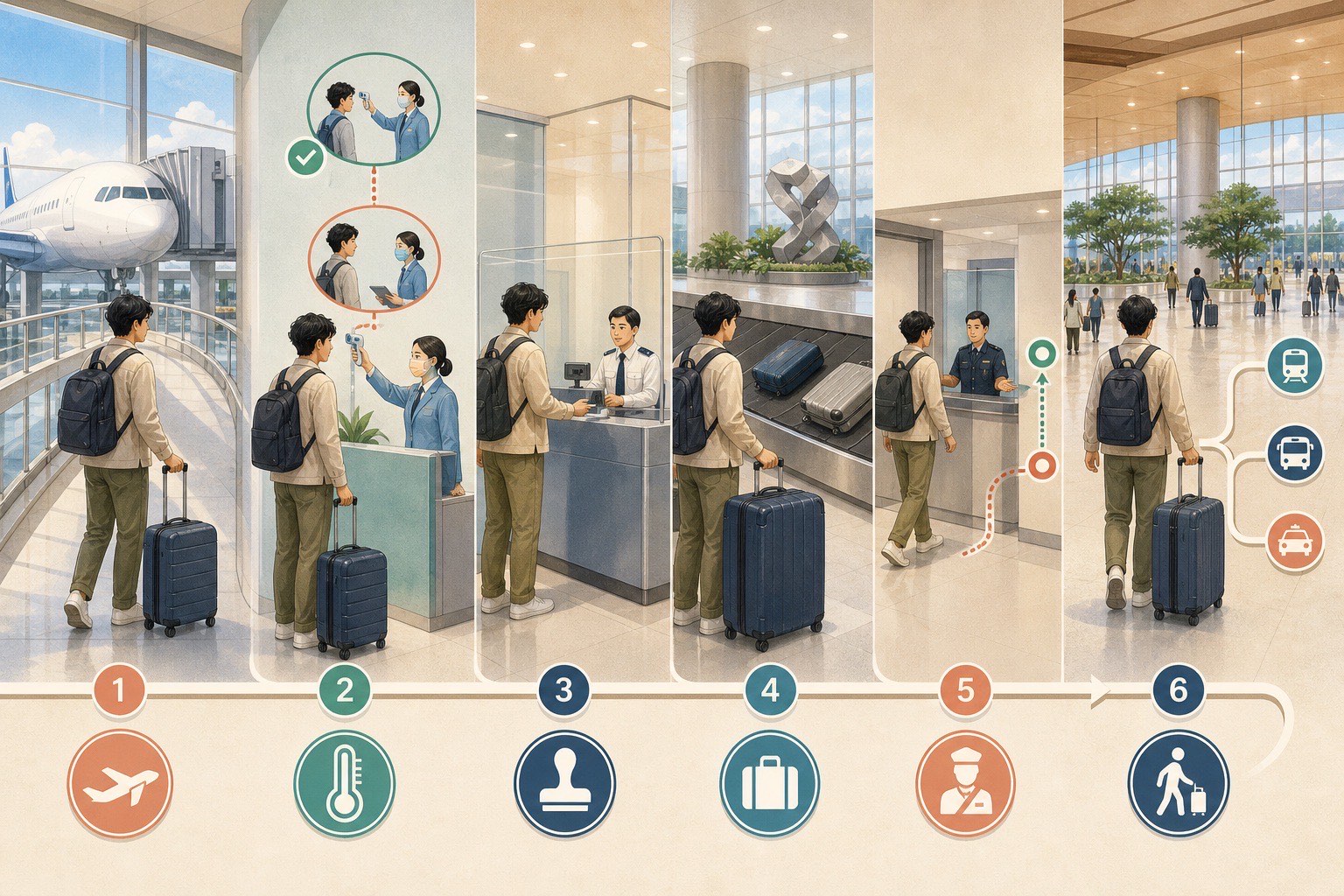
The quick sequence
| Stage | Do | Do not assume |
|---|---|---|
| Aircraft or concourse | Follow the live terminal route and concourse shuttle train when directed | An airline always uses its usual terminal |
| Quarantine | Follow current health screening and submit information only when required | Every traveler needs Q-CODE |
| Immigration | Present the passport and applicable entry declaration | K-ETA, a visa and e-Arrival Card are interchangeable |
| Baggage claim | Confirm the live carousel, collect each bag and report problems before leaving | A missing bag is just as easy to record outside |
| Customs | Declare goods when required and keep evidence accessible | Duty-free or low price means unrestricted import |
| Arrival hall | Confirm the exit and use official transport or a verified pickup | An unsolicited ride or unmatched name sign is your booking |
First decide: entering Korea or transferring?
This guide is for a visitor passing Korean immigration to enter the country. An international transfer passenger may remain airside, follow transfer signs, clear transfer security and continue without collecting checked baggage.
Check the baggage tag, boarding pass, operating-airline instructions and Incheon international transfer route. Separate tickets, an overnight connection or a carrier change can produce a different process, but none alone proves that Korean entry and baggage collection are required. If baggage is tagged only to Incheon, confirm entry eligibility and the collection/recheck process before leaving the transfer route.
Confirm the actual terminal and concourse path
Incheon warns that codeshares and airline circumstances can make the actual terminal differ from a general airline assignment. Save the operating carrier and flight number, then check the live arrival record for terminal, arrival gate, baggage carousel, exit and status.
Asiana Airlines confirms that Asiana-operated Incheon arrivals have used Terminal 2 since 00:00 KST on January 14, 2026. A codeshare can still use another terminal: identify the operating airline and recheck the live arrival record rather than relying only on an OZ marketing flight number.
Concourse arrivals follow signs to the 24-hour shuttle train into the terminal. Follow the one-way arrival flow instead of choosing a route from a departure map. Friends or drivers outside should use the current arrival exit rather than an assumed door.
Keep these items accessible
- The passport used for entry.
- The required arrival declaration or retrieval details, when applicable.
- Health information requested for the current origin or circumstances, when applicable.
- Baggage tags and the airline's delayed-baggage contact.
- Customs receipts, values, prescriptions, permits or certificates.
- The Korean accommodation name, address and contact.
- The official ground-transport or pickup confirmation.
Save critical details offline. Immigration and customs requirements do not disappear when roaming or airport Wi-Fi fails.
Quarantine requirements are conditional
Incheon says international arrivals undergo quarantine inspection, while passengers from current key quarantine-management regions submit Q-CODE or a Health Status Questionnaire. Aircraft checks apply only to applicable flights, and health officers may direct further steps.
If you feel unwell or receive an onboard instruction, follow staff directions. Passenger health screening is separate from animal, plant and food quarantine for items you carry.
Immigration: passport and the declaration that applies
Korean and foreign-national lines are generally separate. Foreign visitors present a passport and, when required, an arrival declaration. Officers may conduct face checks and ask questions; Incheon currently says foreign nationals aged 17 or older provide fingerprints and facial recognition data during inspection.
The free e-Arrival Card replaces the paper arrival card for travelers required to file. Registered foreign nationals, valid K-ETA holders and other groups can be excluded, but eligibility depends on the document used for entry. Use the official navigator rather than nationality alone.
Do not count on an automated lane or a fixed processing time. Eligibility, lane operation, flight banks and document questions vary. Use the staffed lane when directed or when status is uncertain.
Baggage claim: match the live carousel and tag
After immigration, check the current carousel on the live flight record and airport displays. Match each tag before leaving and inspect wheels, handles, locks and shell damage while the airline or handling desk can record the condition.
If a bag is missing or damaged
Do not leave the controlled baggage area first. Follow the airline or handler instruction near the carousel, present the bag tag and boarding pass, and obtain a written reference number plus delivery or collection instructions. Record the bag description and a reachable Korean contact. Use the Incheon lost baggage and property guide to separate airline baggage from aircraft, terminal, bus and rail losses.
Keep receipts for essential replacement purchases, but do not assume reimbursement or delivery time. Carrier rules vary. For an onward separate ticket, confirm collection and recheck with both operating airlines; do not leave a bag on the belt because the next flight departs from Incheon.
Customs follows baggage collection
You can prepare a declaration earlier, but the accompanied-baggage decision is made with the goods collected. Travelers with declarable items use Goods to Declare and can currently use paper or the official mobile/web route. Travelers without declarable goods can omit the form and use Nothing to Declare while remaining subject to inspection.
The general allowance is not universal import permission. Food, plants, animal products, medicines, commercial goods, temporary imports, protected wildlife products and means of payment can have separate requirements. Use the dedicated customs guide and ask before Nothing to Declare if uncertain.
Goods quarantine is separate from tax
Incheon publishes separate contacts for passenger health, animal, plant and marine-product quarantine. A low-value item may still need inspection when no duty is due. Keep packaging and ingredient labels intact. Meat, fruit, vegetables, seeds, plants, animal products and other foods can be regulated.
A souvenir made from protected wildlife can raise CITES issues even when sold openly abroad. Airline acceptance and foreign retail packaging do not establish Korean import permission.
Enter the public arrival hall
After immigration, baggage and applicable customs or quarantine steps, follow the signed exit to the public hall. Recheck the live arrival exit before meeting anyone. Then confirm every companion and bag, connect prepared mobile data if needed, open the route to the accommodation entrance and verify the live train, bus or licensed taxi option.
Contact a booked driver only through saved operator details. A genuine record should identify the operator, meeting point, passenger and contact route. Do not follow an unsolicited offer or a name sign that does not match.
Choose ground transport after baggage claim
AREX rail, airport buses and taxis solve different final journeys. Rail can be fast but require transfers or stairs. A bus may reach a hotel district directly but has a route-specific final service. A licensed taxi can suit a group or large luggage.
Check live service after baggage claim because immigration or baggage delay can remove the planned final train or bus. For late-night arrival, keep a second licensed option and accommodation late-check-in instructions.
Arrival-day checklist
- Operating carrier, terminal and transfer/entry path confirmed.
- Current quarantine requirement checked.
- Passport and applicable arrival declaration accessible.
- Live carousel and arrival exit checked.
- Every bag matched and its condition reviewed.
- Missing or damaged luggage recorded before leaving.
- Customs and goods-quarantine decision completed.
- Accommodation and verified ground transport confirmed.
Official sources
- Asiana Airlines: Incheon Terminal 2 relocation effective January 14, 2026
- Incheon Airport: Arrival Procedures
- Incheon Airport: Passenger Quarantine
- Incheon Airport: Manned Arrival Immigration and e-Arrival Card
- Incheon Airport: Live Arrival Record
- Incheon Airport: Arrival Customs
- Incheon Airport: Government Offices
Official sources were rechecked August 27, 2026. Recheck terminal, carousel, exit, quarantine requirements and transport on arrival day.