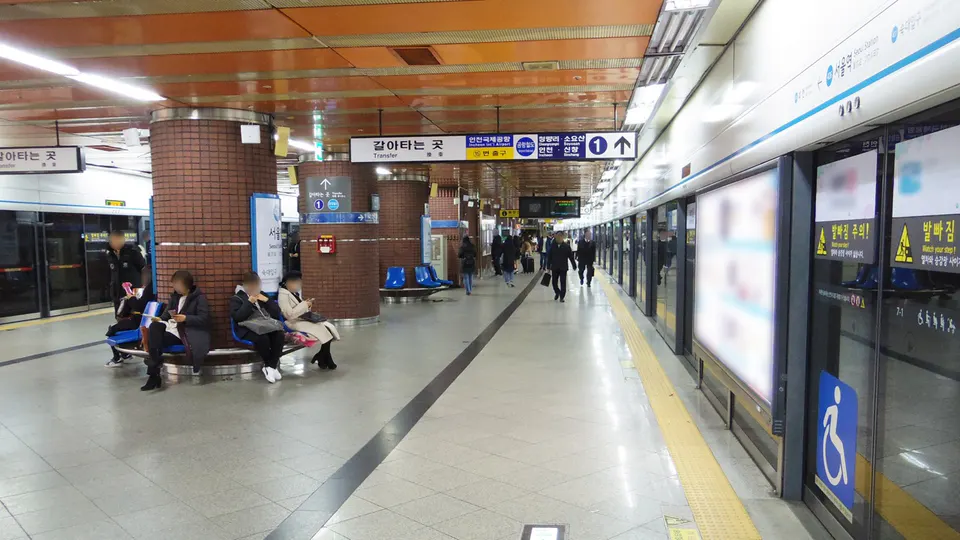
Understanding the loop structure
Line 2 is Seoul's only fully circular subway line, running as a closed loop around the city's core rather than a point-to-point route, which makes it structurally different from every other line in the network. This loop design means there's no single "end" station, and trains run continuously in both directions (clockwise and counterclockwise) around the circle.
Key interchange stations worth knowing
- Gangnam Station connects to Line 2 and puts you in the heart of the Gangnam business and shopping district.
- Sadang Station connects to Line 4, a useful transfer point for reaching the southern part of the city.
- Wangsimni Station connects to the Bundang Line and Gyeongui-Jungang Line, useful for reaching Seongsu and points east.
- Sindorim Station connects to Line 1, a major transfer hub for western Seoul and routes toward Incheon.
Using Line 2 for efficient cross-city connections
Because the loop touches so many of Seoul's major districts -- Hongdae-adjacent Sinchon, Gangnam, Seongsu, and more -- Line 2 often functions as a practical connector line for reaching a transfer point rather than a direct destination in itself. For a longer stay, learning which direction around the loop gets you to a given interchange faster saves meaningfully more time than picking a direction at random.
Because Line 2 intersects with so many other lines around its loop, it often makes sense to think of it as a connector route for reaching a transfer station rather than plotting your entire journey along it directly. Peak commuting hours on Line 2 can be notably crowded given how many transfer passengers pass through its key stations, so timing a trip outside rush hour when possible makes for a more comfortable ride. Digital maps and station announcements are generally available in English throughout the line, easing navigation for first-time subway riders.
Official sources
Time-sensitive details were checked against the original sources below on 2026-08-28.