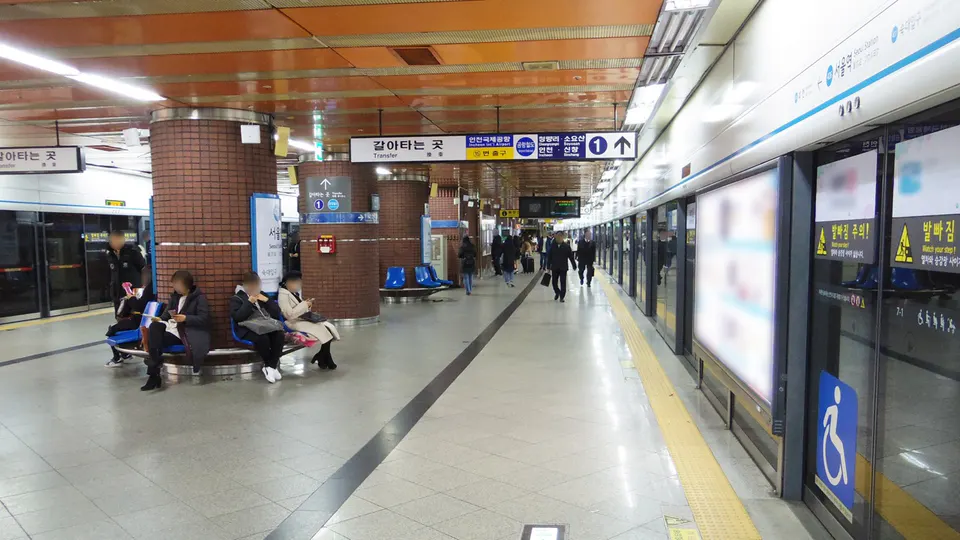
Why some transfers take far longer than others
Seoul's subway system was built out over decades by different operators and construction phases, so lines sharing a station name don't always share a platform level or even a connected concourse built at the same time. Some transfers are a short cross-platform walk; others require going up or down multiple levels and walking several hundred meters of connecting corridor, especially at older or more complex interchange stations.
Transfers worth planning extra time for
- Large multi-line interchanges like Gongdeok, Wangsimni and Dongdaemun History & Culture Park are known for longer connecting walks than a typical two-line transfer.
- Transfers between older lines (1-4) and newer lines built later (Bundang, Shinbundang, Gyeongui-Jungang) tend to involve more walking since they weren't designed as a single connected structure from the start.
- Exact walking times shift as stations get renovated, so treat any specific number as approximate rather than fixed.
Practical tips for a tight connection
If you have a train or flight to catch, build in extra buffer specifically around a transfer rather than assuming every change of line takes the same time.
- Check your maps app's estimated transfer time before treating a multi-line route as fast, rather than assuming all transfers are equally quick.
- Follow the overhead line-color signage rather than guessing -- long transfer stations are usually well signed, just long.
- When timing is tight, consider whether a single-line route (even if it takes a few extra stops) beats a shorter-looking route with a long transfer in the middle.
None of this means a long transfer should be avoided outright -- these are still normal, everyday interchanges used by millions of commuters -- it just means the phrase "same station" can hide a genuine walk. Treating a long-transfer station like its own short leg of the journey, rather than an instant hop between lines, is usually enough to keep a tight schedule intact.
Official sources
Time-sensitive details were checked against the original sources below on 2026-08-28.