Food allergies in Korea: a safer ordering checklist
Before the trip
- Ask a qualified translator or clinician to check your Korean allergy statement.
- Carry the statement on paper and offline on your phone.
- Learn the Korean word for each allergen and common derived ingredients.
- Pack medication in your hand luggage with the prescription information you need.
- Save 119 for medical emergencies and 1330 for non-emergency visitor interpretation.
I have a severe allergy to [allergen].
육수, 소스, 양념에도 들어가면 안 됩니다.
It must not be in the broth, sauce or seasoning either.
같은 조리도구나 기름을 사용하나요?
Do you use the same utensils or cooking oil?
Packaged food labels
Korea's Ministry of Food and Drug Safety requires designated allergens to be identified on applicable packaged foods. Because the regulated list and labeling rules should be read from the current official guidance, do not rely on a copied list from an old travel post. Read the full ingredient and allergen sections; camera translation is a convenience, not a medical guarantee.
Warnings may also indicate possible unintended mixing from shared manufacturing equipment. Products imported into Korea can have a Korean label attached to the package. If a label is damaged, covered or unclear, do not guess.
Recognize the label sections, not just one word
Look for 원재료명 (ingredients) and a separate allergen statement that commonly uses 함유 (contains). A precaution about the same manufacturing process can indicate possible unintended mixing. Check the exact flavor and package size because products under one brand can use different ingredients. Translation software can help you locate text, but it cannot resolve a cropped label, compound ingredient or ambiguous factory warning.
Korea's designated disclosure list is a regulatory list, not a complete inventory of everything a traveler could react to. If your allergen is outside that list, a missing highlighted warning is not evidence that the product is safe. Read the full ingredients and use the personal plan agreed with your clinician.
Use a three-part allergy card
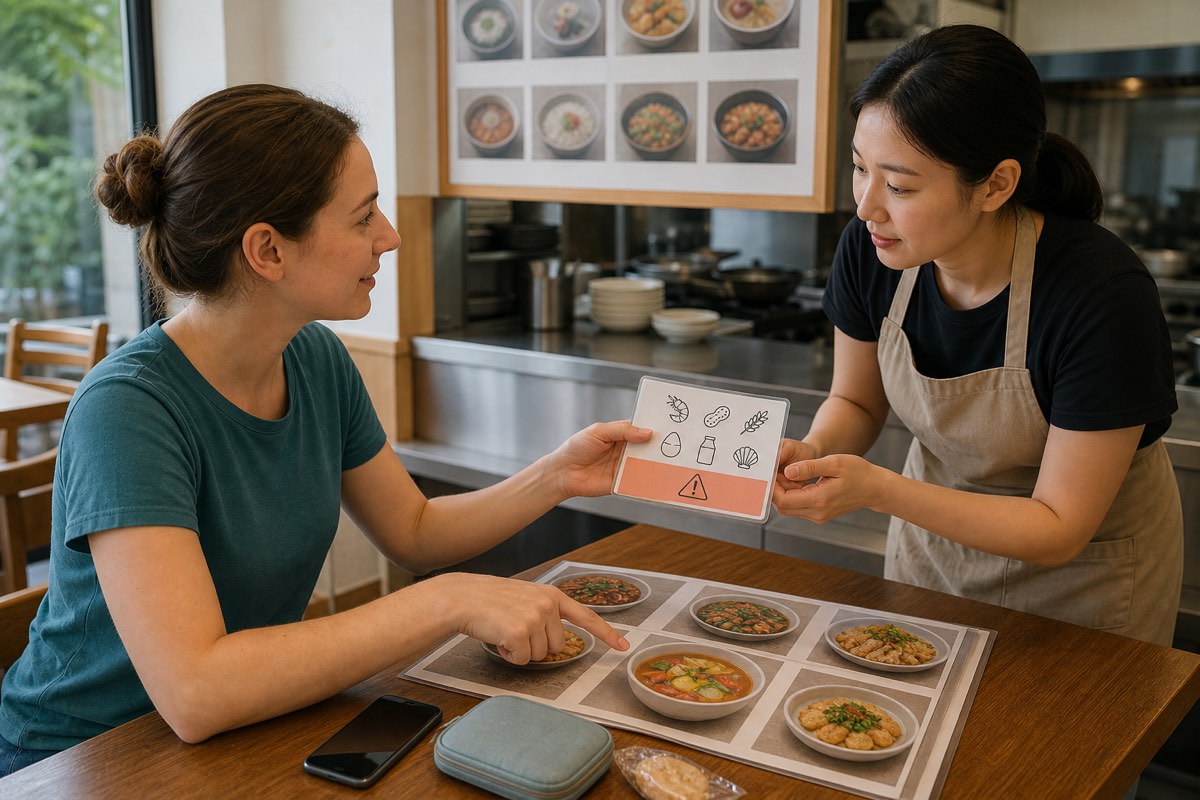
The card should name the exact allergen, state the consequence or severity in plain language, and explain whether broth, sauce, shared oil or utensils are unacceptable. Avoid vague categories such as “nuts” when particular nuts or seeds matter differently. Have the Korean text checked before travel and keep both a paper copy and an offline phone copy.
Read labels in a fixed order
- Confirm the exact product and flavor, not only the brand.
- Read the ingredient list and designated-allergen statement.
- Check shared-facility or unintended-mixing warnings.
- Compare imported-product stickers with the original package when possible.
- If any section is missing or unclear, do not treat silence as proof of safety.
Restaurant questions that matter
Ask about stock, marinades, sauces, kimchi seasoning, garnish and frying oil. Removing visible pieces does not make a soup allergen-free. Barbecue grills, hot-pot broth, buffet utensils and deep fryers may be shared. A restaurant that can name the ingredients but cannot control cross-contact may still be unsuitable for a severe allergy.
Ask one dish at a time
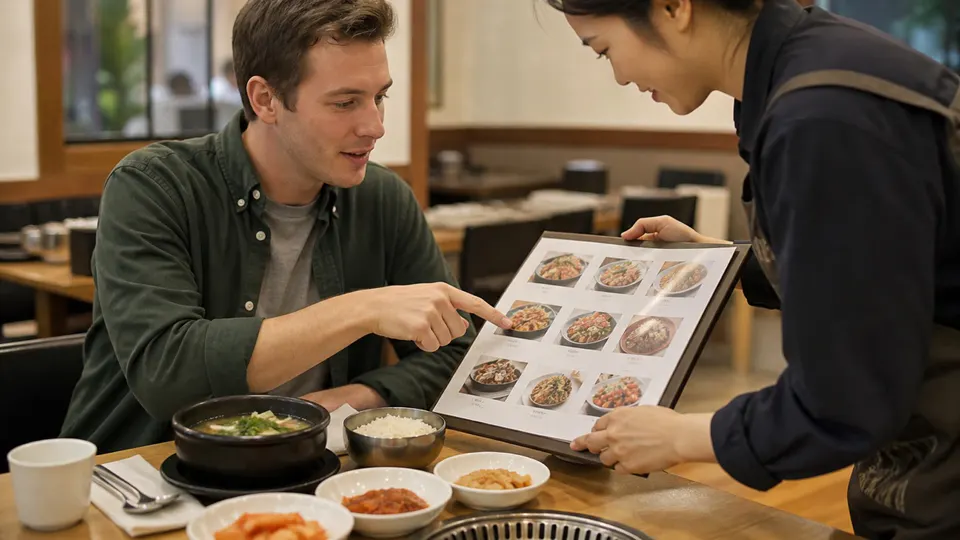
Show the card before ordering and point to one specific menu item. Ask the staff to check the packaged sauce, broth base and garnish rather than asking whether the restaurant is generally “allergy friendly.” If another employee or kitchen worker gives a different answer, stop and clarify. Busy service, delivery-app notes and machine-translated chat are weak places to resolve a severe-allergy question.
For shared-table meals, explain that moving visible food to another plate is not enough. Tongs can move between barbecue items, ladles can move between broths, and a communal spoon can return to a dish. Choose individually portioned food or a different venue when the necessary separation cannot be explained.
Prepare the emergency handoff
Keep prescribed emergency medication immediately accessible and follow the plan given by your clinician. Save the accommodation address and current location in Korean, and make sure a companion knows where the medication is stored. In a serious reaction, call 119 and state the location first; do not use a tourism helpline as a substitute for emergency dispatch.
This is a food-allergy emergency. I need an ambulance.
주소는 [주소]입니다.
The address is [address].
Prepare the Korean address before you need it and send a companion to meet responders when possible. Tell 119 what was eaten, when symptoms began and which prescribed medication has already been used. Follow the dispatcher's instructions and your personal emergency plan; do not delay an emergency call while trying to obtain restaurant paperwork or visitor interpretation.
A practical fallback
Save several dedicated restaurants before each travel day, contact them outside peak hours and keep a packaged backup meal whose Korean label you have checked. Avoid making a late-night convenience store your first attempt at understanding unfamiliar allergen labels.
Use a stop-or-proceed decision
Proceed only when staff understand the exact allergen, can identify the ingredients in the named dish and can explain the relevant cross-contact controls. Pause when the answer refers only to visible toppings, a menu translation or “probably.” Leave when staff cannot check the broth, sauce, seasoning or shared equipment. Choosing another meal is a successful safety decision, not a failed cultural experience.
For each travel area, save a primary restaurant, a second option and a sealed-food fallback. Reconfirm on the day because menus, suppliers and kitchen practices can change. Never assume that a different branch follows the same process.