Where to exchange money in Korea: airport, bank, booth or ATM?
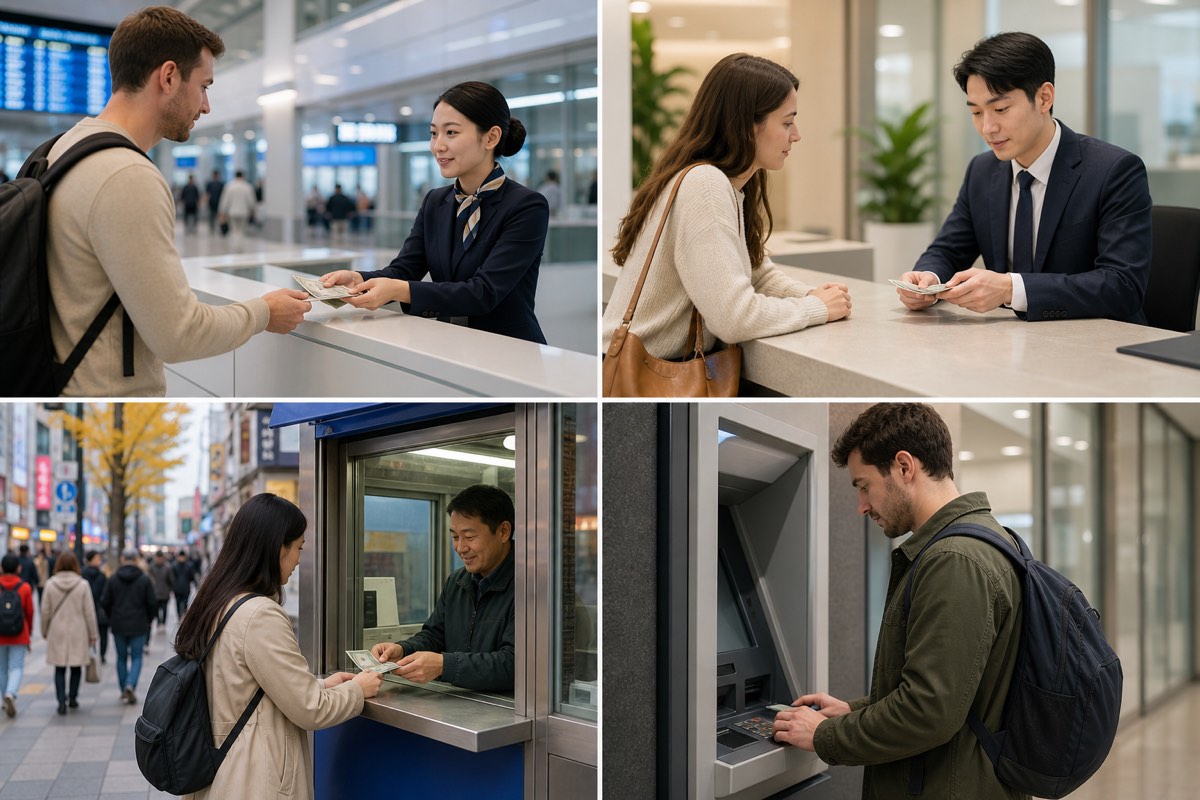
Your four common options
| Option | Useful when | Check before accepting |
|---|---|---|
| Airport counter | You need won immediately, arrive outside city banking hours or want staffed help. | Displayed buy rate, fee, accepted notes, hours and terminal location. |
| Korean bank | You can visit during weekday banking hours and prefer a regulated staffed transaction. | Passport requirement, supported currency, queue, hours and final won amount. |
| Authorized exchange service | You are already in a visitor district and can compare clearly identified providers. | Authorization, rate direction, receipt, fees and accepted notes. |
| ATM | Your debit card supports international withdrawals and you prefer not to carry foreign cash. | Operator fee, issuer fee, limit, DCC offer and foreign-card support. |
Choose by arrival window, not reputation
A recommendation for a weekday afternoon may be useless after a delayed late-night arrival. Write down your terminal, estimated immigration exit time, first transport payment and hotel location. Check the airport's current facilities page for an option you can actually reach. If a staffed counter is closed, an internationally enabled ATM may be the practical backup; if your card issuer blocks overseas cash withdrawals, it is not.
Do not cross Seoul to chase a small advertised advantage before comparing transport cost, queue time and the amount being exchanged. A staged approach is often easier to verify: obtain only the arrival amount at the airport, then compare regulated city options for the remainder.
Airport exchange is a convenience decision
Incheon International Airport lists bank branches, exchange counters and ATMs in both terminals. Some counters operate long hours and selected facilities are listed as 24-hour services, but hours and locations can change. Use the airport's official facilities search for your terminal and arrival time rather than relying on an old screenshot.
Exchanging a smaller arrival amount can be sensible if it lets you buy or load the transit product you need, reach accommodation and eat without payment stress. Compare city options later when rested.
Banks and authorized services
VISITKOREA advises visitors to use a bank or authorized exchange service. Its currency guide says banks generally operate around 09:00–16:00 on weekdays, while hours vary by institution and region. A branch may not accept every denomination or old or damaged notes, so check ahead for less commonly exchanged currencies.
Confirm which direction the posted rate uses. A sign may show the provider's price for buying or selling currency, not the amount you assumed. Ask for the final Korean won amount before handing over cash and keep the receipt.
Check a counter before handing over money
- Confirm that it is a bank or clearly identified authorized exchange service, not a person offering a private swap.
- Show the currency and denomination without releasing it, then ask whether old, marked or damaged notes are accepted.
- Ask how many Korean won you will receive after every fee. Repeat the number or use a calculator if language is a barrier.
- Count the won in view of the counter and compare it with the receipt before leaving.
- Keep the receipt separately from the cash; it can help explain the transaction or support a later re-exchange request.
Walk away from pressure to decide immediately, a refusal to state the final amount or a request to move the exchange into a private space. A better-looking headline rate does not compensate for an unverified transaction.
ATM cost has more than one layer
A withdrawal can include a local operator fee, your bank's foreign ATM charge and your issuer's conversion cost. The screen may offer dynamic currency conversion into your home currency. Read both amounts and any markup before accepting. If terms are unclear, decline the offered conversion and decide whether to continue in KRW.
Use an ATM in a bank, airport or controlled indoor location when possible. Shield the PIN, reject unsolicited help, retrieve the card and receipt, and contact your issuer through its official app or number if the machine keeps the card.
Make the first ATM withdrawal a test
Before travel, enable overseas withdrawals if your issuer requires it and check the card's network, daily limit and support number. At the machine, select a reasonable test amount rather than the maximum. Read the operator fee and any conversion offer. A completed withdrawal proves that one transaction worked; it does not guarantee the same card will work at every Korean ATM.
If the ATM reports a decline, do not repeat the same attempt many times. Check the amount, issuer settings and network logo, then try an official machine in another controlled location or contact the issuer. If the account shows a debit but no cash was dispensed, photograph the machine identifier and time without exposing the PIN, keep the receipt and contact both the ATM operator and issuer.
A five-minute comparison
- Write down how much foreign currency you will spend.
- Ask each option for the final KRW delivered after its fee.
- For an ATM, include the displayed operator fee and issuer charges.
- Value convenience: a long trip to save a small amount costs time and transport.
- Split the exchange when uncertain instead of committing the entire trip budget.
What visitors appreciate—and what causes confusion
Helpful: airport facilities make it possible to obtain won immediately, and banks or authorized services provide staffed alternatives. Common confusion: comparing a mid-market online rate with a retail cash or ATM transaction without spread and fees. Compare the actual final amount.
Plan the end of the trip
Stop replenishing cash during the final days and use small won balances for ordinary expenses rather than creating another exchange transaction. Coins and small notes may be difficult or uneconomic to convert back. If you expect a meaningful remainder, check whether the airport or a bank handles your target currency and what receipt or identification it requires before departure day.
This page deliberately does not prescribe how much cash to carry. Use the separate Korea cash-planning guide to calculate an arrival reserve; return here only to choose the safest acquisition method.
Currency exchange questions
Can you exchange currency at Incheon Airport?
Yes. Incheon Airport lists bank branches, exchange counters and ATMs in both terminals. Locations and hours can change, so use the airport’s official facilities search for the terminal and arrival time.
Is it better to exchange money at Incheon Airport or in Seoul?
Airport exchange is primarily a convenience decision. Obtain enough won for arrival if needed, then compare the final amount, fees, opening hours, queue and travel cost before exchanging the rest at a bank or authorized city service.
Is an ATM better than a currency exchange counter in Korea?
It depends on the card and transaction. An ATM withdrawal can include a local operator fee, the home bank’s foreign ATM charge and currency conversion cost. Compare the final won received and reject an unclear home-currency conversion offer.
How much cash can a traveler bring into Korea without declaring it?
Korea Customs Service states that means of payment not exceeding USD 10,000 do not require a declaration on arrival. Foreign currency, Korean won or checks above USD 10,000 or the equivalent in total must be reported to Customs. Check current official guidance for the traveler’s situation.